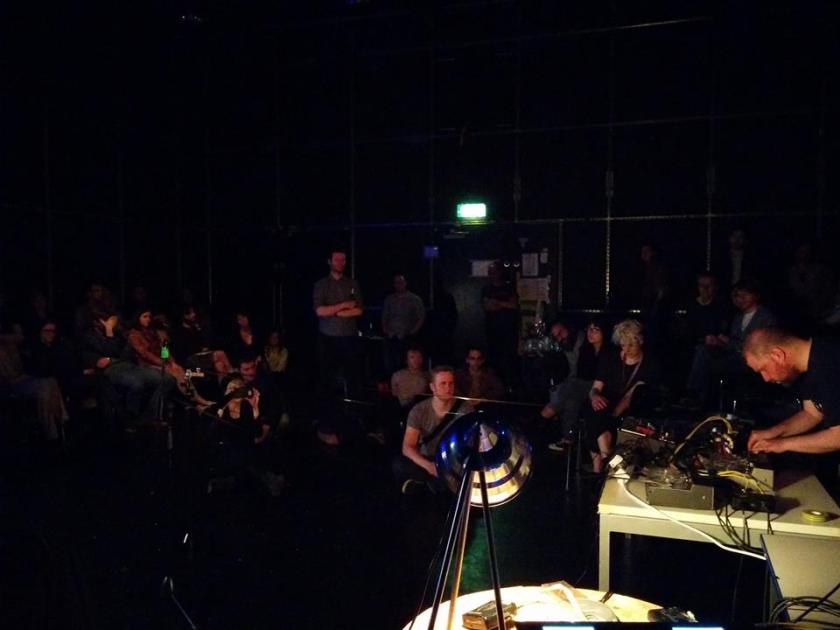
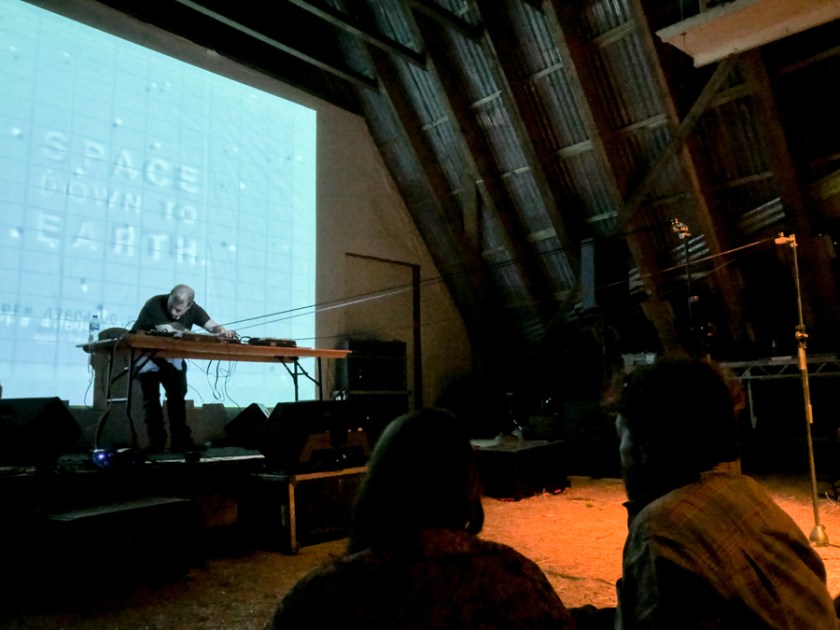
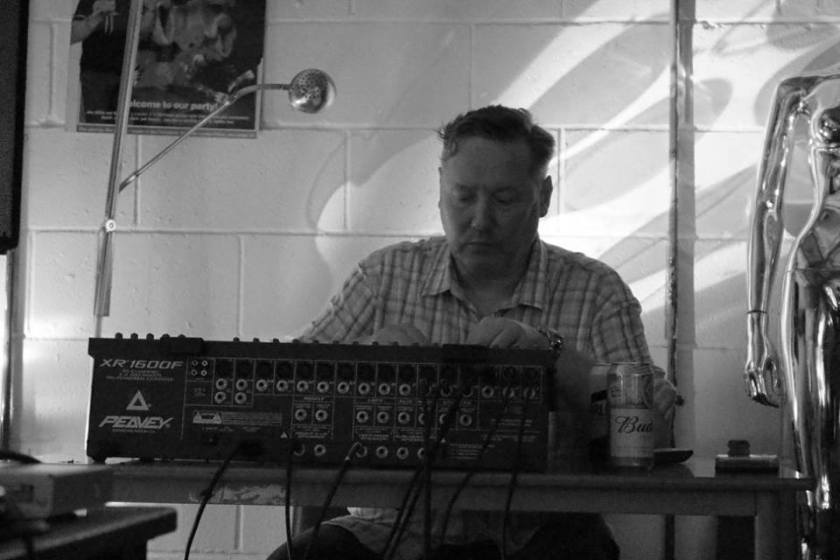
Hello You. Before I get to the main thrust of that headline, allow me to stir in some additional intrigue by inviting you to enjoy this extract from my set at the recent Tapeworm 100 event at Iklectik; where that fine label celebrated their centennial emission – the whopping 36-track compilation A Can Of Worms, featuring amongst other delights an exclusive Howlround track and artwork by Savage Pencil – by throwing an extravaganza at one of my very favourite venues. Featuring live performances from such luminaries as Dale Cornish and Phil Julian, Simon Fisher Turner, Marta De Pascalis and more, for my own part this might well have been Howlround’s noisiest set to date, as I decided to use the venue’s excellent sound system and the presence of ever-patient sound engineer Ilia Rogatchevski to give the equipment a bit of a push. Though in truth it’s not as if I need too much of an excuse to go heading down the noisy rabbithole at the moment – I’ve been getting really into pure feedback lately and thankfully it seems my neighbours are quite into it as well. Three cheers, then, for the Tapeworm, for label heads Mike and Philip and of course for Eduard and the Iklectik posse. If you haven’t yet visited this brilliant little corner of Lambeth yet, do so with haste. It’s rapidly becoming the Cafe Oto of South London!
Which brings me semi-seamlessly to the Cafe Oto of North London, aka the actual Cafe Oto, where Howlround will be heading back down that rabbithole again this Friday in their Oto Project Space, alongside Leafcutter John and CTRL FREQ. Details and tickets here. It promises to be a mighty event, not least because it marks a rare UK appearance from legendary self-styled ‘circuit bender, sonologist, vagabond, improviser, music producer, audio-hacker, instrument designer, nomad, radio presenter, workshop leader, squatter’ Kacper Ziemianin, a man more often found making mischief around The Hague. And it’s not as if Mr. Leafcutter’s work is in any need of an introduction, is it? Take full advantage of their presence!
Brighton friends! A Creak In Time, the critically-acclaimed film by Steven McInerney for which Howlround provided the soundtrack is screening at The Green Door Store this Sunday as part of Splitting The Atom XXXIX experimental/free/noise all-dayer. And it’s free! Further details here.
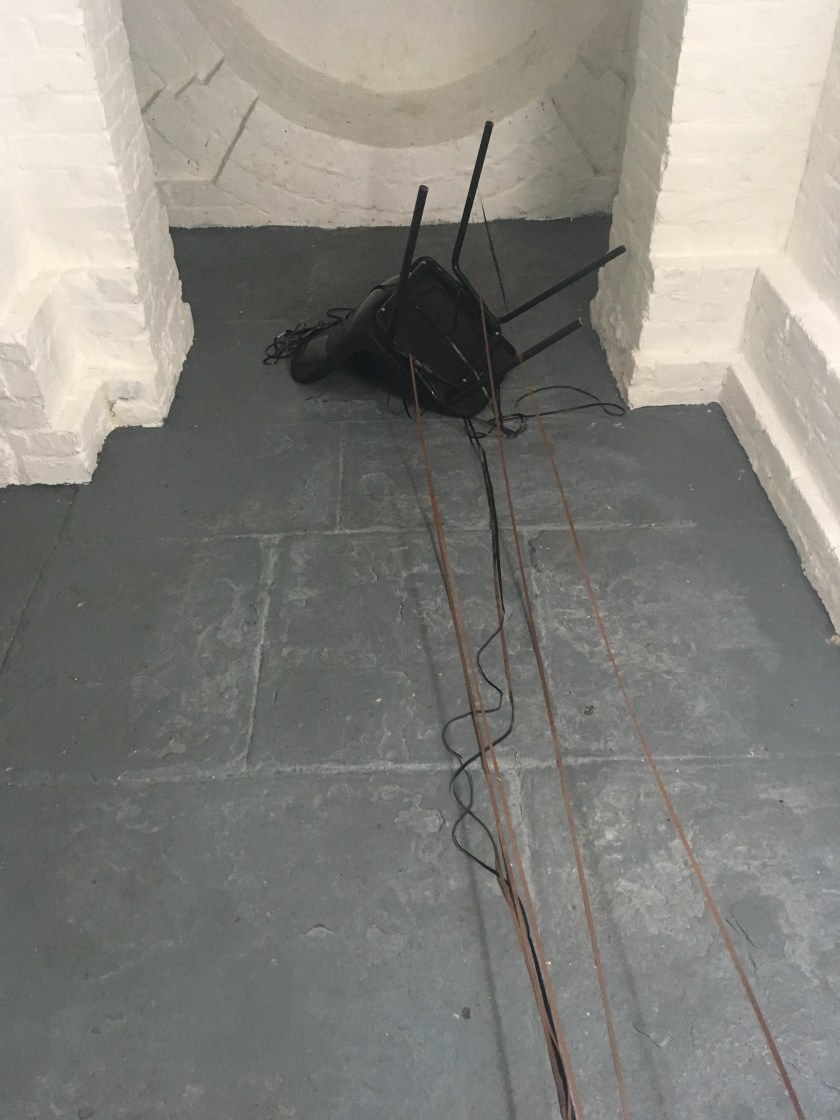
And lastly, thanks to everyone who ventured down to the Crypt at the all-day electronic music festival that was 22rpm, to check out the Howlround tape loop installation stretched across the tunnels beneath the historic church of St. John. This proved yet another perfect location for my programme of haunted drones and wonky loops – which was just as well as the increasing humidity caused them to contract, resulting in things getting even wonkier than usual and causing some frequently beautiful happy accidents – plus the gradual death of both loops, all captured on my recorder for prosperity. I will put an official extract online at some point soon, once I’ve had time to properly go through the material (due to various commitments my life is currently about a week behind schedule), but in the meantime huge congratulations must go to Léigh and the Bit-Phalanx team for putting on their finest event yet. And not forgetting to send big Martian love as ever to my old pal Coppé, visiting us once again from Mars and this time rocking a show-stealing costume that for some reason put me in mind of a giant squid, with a hat in the shape of a giant tooth completing the look. Naturally you’d don’t spend an hour backstage being helped into this kind of attire for nothing, and while I missed the set due to my subterranean untangling duties, I’m told the tracks from new album Milk went down a storm. It’s out now on CD and ‘puddle’ coloured vinyl. Order it here. It’s good to have her back!
Ben from Lightrhythm Visuals, Coppé from Mars and me from, er, Penge.
Those of you who like to be tucked up nice and early of an evening might have missed my latest BBC report for Radio 4’s evening news programme The World Tonight a couple of days back on the subject of Mike Dixon, his lathe cutting empire and his current accompanying of Michael Nau on tour; so I’ve decided to upload it to Soundcloud for your listening pleasure:
A native of Arizona, Mike has a reputation as a sort of ‘Lathe-Master General’, having cut literally thousands of records in the last decade or so – his releases endlessly varied not just in style but in shape, size, colour and substance, many pressed on ‘up-cycled’ junk and surfacing on his own labels such as PIAPTK and Soild Gold. Marketed largely at bands looking for short runs, limited editions and unusual items to sell on tour, each of Mike’s discs are cut by hand in real time and usually come with homemade artwork to match.
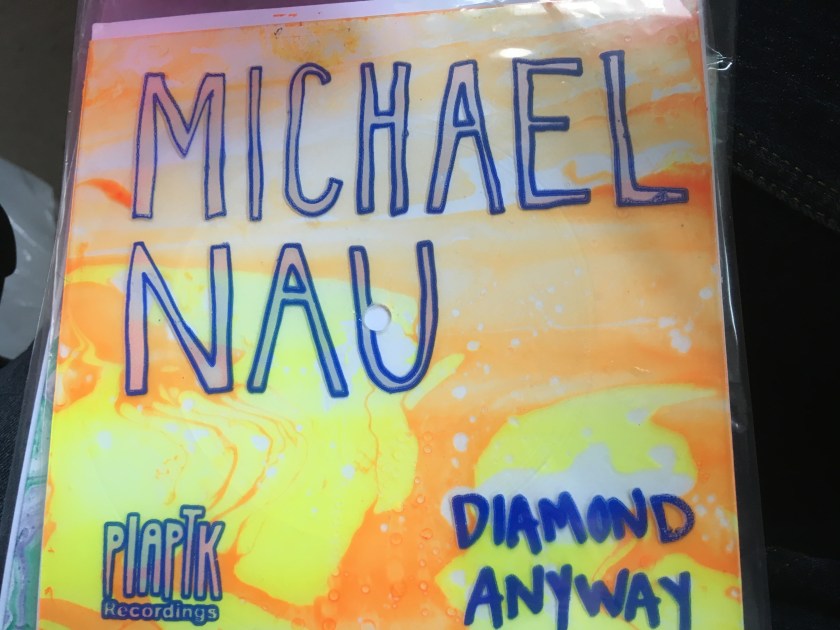
Michael Nau lathe-cut tour souvenir
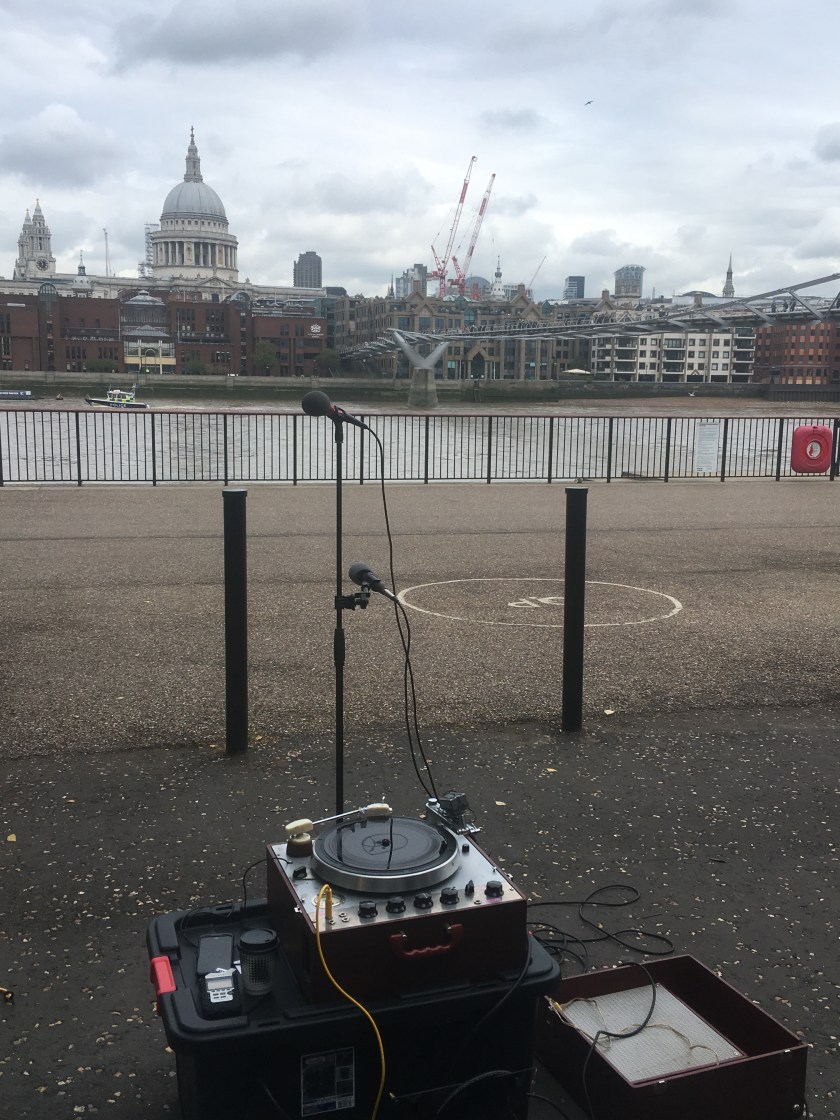
As Michael Nau is currently on tour around Europe promoting his rather fine second solo LP Some Twist, the scheme was hatched to have Mike and one of his lathes accompany him, documenting the tour and making Alan Lomax-style field recordings at various historic sites around Europe such as Stonehenge, the Brandenburg Gate and so on. Furthermore, as well as a limited series of tour-only lathe singles like the one in the above picture, a special invitation would allow a small number of fans to stay around after each show and pay to have a song of their choosing performed and cut to disc in front of them; resulting in a one-of-a-kind record that would be theirs to keep. An absolutely brilliant idea, I thought when I first heard about it, especially as Michael’s delightfully wonky acoustic numbers seem to particularly suit this lo-fi approach. It doesn’t require too much of a conceptual leap to imagine how excited I was at the mere thought of all this, so I’m sure you wouldn’t have been at all surprised to spot me a short time later helping to wheel a large amount of heavy equipment onto London’s South Bank just outside of the Tate Modern.
The original location of choice had been The Houses of Parliament in order to capture the chimes of Big Ben, but when a mutual friend reminded us all that the bell was currently ‘bong-free’ and would remain so for the next four years [#FAIL], it fell to this long-term Londoner to nominate a alternate spot. I chose the grounds outside the Tate Modern because you can pick up the chimes of St Paul’s quite well from its position on the opposite bank, while secretly being slightly relieved that we were to avoid Parliament Square – you can readily imagine how quickly setting this lot up in that area would get you moved on – and moving anywhere with this much equipment is enough of an undertaking already! In the end, however, all went well and Michael made the first of what will hopefully be numerous field recordings throughout this tour, all to be compiled into an album and accompanying documentary at a later date.
The actual BBC report being cut. The inner ring you can see is a stream of lacquer that that cutting head removes from the disc as it makes the groove.
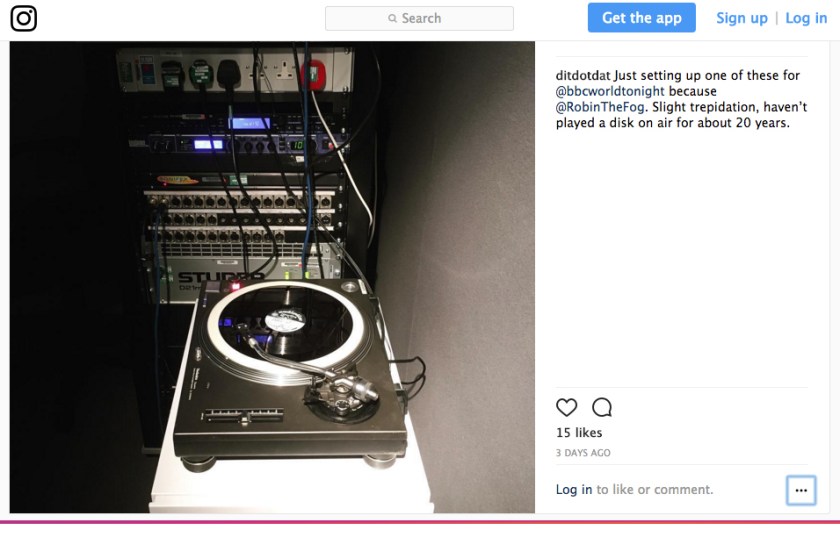
Having edited and mixed the report before sending it over, I caught up with the pair a few days later for their show at the Lexington in Islington – and for the grand cutting. I was told that the lathe – a restored model from the 1950s – had only broken down several times in the intervening days, and so was considered to be putting in a very strong performance. Nonetheless, it was a rather nail-biting process. Would it co-operate at this crucial moment? Would the resulting disc play back properly on unfamiliar equipment – especially a BBC turntable (that had probably been gathering dust for a while) during a live programme? Would we even have time to cut it with Michael’s band waiting impatiently in the wings, and… actually now on stage and tuning up? ‘Hurry, Mike! But no sudden movements!’, I thought.
Insta-Gramm!
Thankfully, as appears to have been a continuing theme on the tour thus far, everything came together at the last possible moment. The report was cut in a single take from Mike’s place at the side of the stage, while signalling ‘two more minutes!’ at an impatient crowd and imploring assorted drummers and bassists not to ‘jump around too much’. The resulting disc, signed by both Michaels and labelled ‘SUPER FRAGILE’ by me was delivered to New Broadcasting House the following lunchtime. It closed the programme that evening and was, as presenter Ritula Shah points out, the first BBC radio report ‘on an analogue disc’ for at least fifty years. ‘Of course we asked Robin to cut his entire report onto vinyl so we could be part of the experiment too’, she says in her cue (technically it was my idea, but let’s not split hairs), ‘so bear with us and just forgive the crackles and the static’.Forgive? Really?!
This slideshow requires JavaScript.
I thought it sounded smashing, personally – and certainly better than many of the poor quality phonelines and Skype connections that I had to endure passing through my mixing desk during my tenure with the Corporation. ‘I have to say I can’t cope with the static’, Ritula comments as the piece concludes with Michael’s performance outside the Tate Modern; to these ears a lovely acoustic number transformed into a vintage blues lament with just the right amount of crackle. I wonder how many listeners would have spotted much difference if they hadn’t had their attention drawn to its unusual delivery mechanism? Or maybe I’ve just been playing around with degraded tape loops for too long?
Anyway, fidelity-based quibbles aside, the programme is still available here at the time of writing, so have a listen to the pre-cut version on Soundcloud and then the broadcast version on iPlayer and see if you can hear all that much difference, considering. The tour continues with the two Michaels still lugging a surprisingly heavy amount of equipment around Europe and Some Twist is available now from all good record shops. Travel safely with your precious cargo, gentlemen!
In other broadcast-tastic news, I shall be helming the Sunday 12-2pm slot on WNBC this weekend, broadcasting live from The Book And Record Bar in fashionable West Norwood. I have absolutely no idea what I’m going to play yet, but of course it’s going to be massive – so please do tune in, or better still come down to the shop to say hello and have a browse. As well as the records, there will be beer and coffee served by amiable host Michael, and as it’s West Norwood’s monthly FEAST event, the shop might be running their famous CAKELAB as well! Come on down!
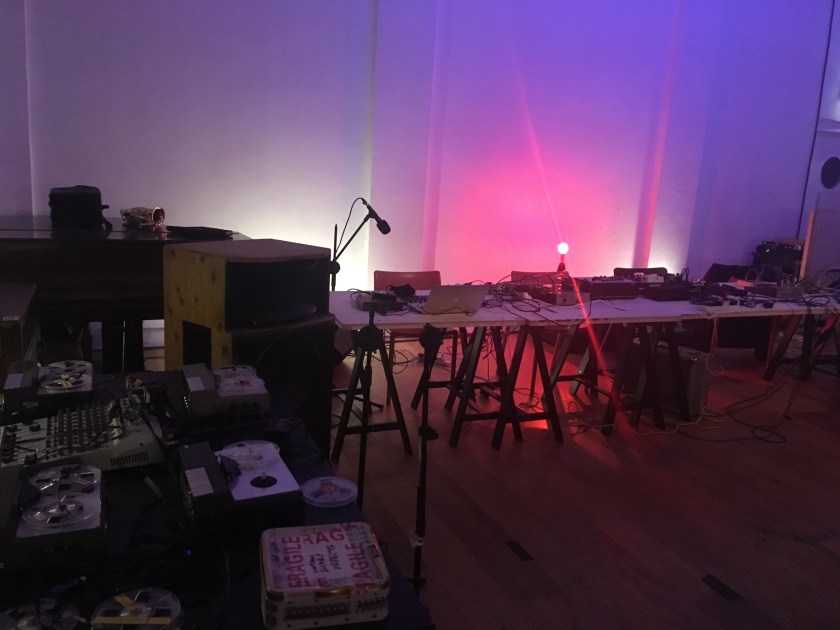
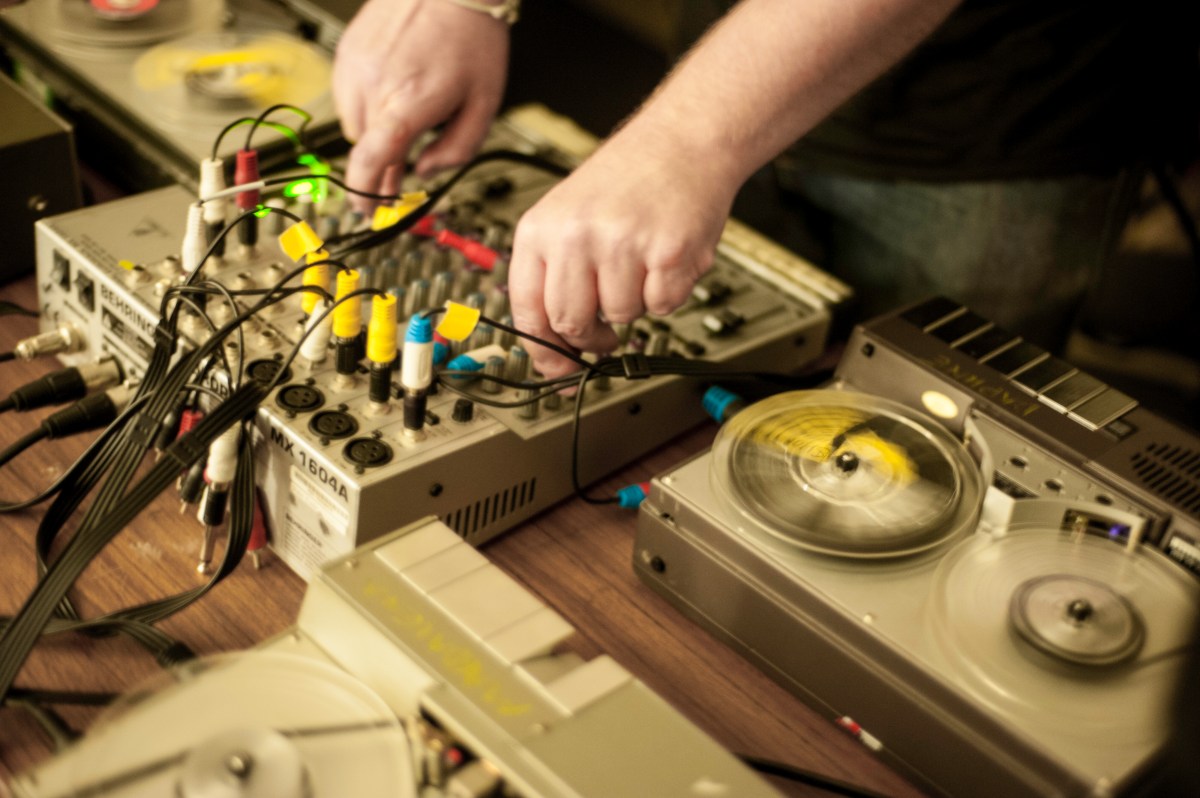
I will certainly be writing more on the event (and hopefully digging out an extract) in the coming days as it was one of my favourite shows of the year thus-far, I just need a bit more time to go back through the recordings first! For now, here’s a picture taken immediately post-soundcheck and pre-dinner, which will hopefully whet your appetite (mo pun intended). With all that equipment between us it’s a wonder we managed to squeeze such a big crowd in!
super brutal and beautiful set by the always excellent @Howlroundmusic yesterday at @iklectikartlab – feedback at its very best!
In other news, if you happen to be in the vicinity of Cambridge this Tuesday, October 3rd, I’ll be giving a talk about my work and a short demonstration from around 5pm as part of the series of Alchemical Landscape lectures at the University’s Centre for Research in the Arts, Social Sciences and Humanities (or CRASSH). Very much looking forward to meeting up with curators Yvonne and James again – and hopefully a few of the people I met last year while playing at one of the city’s long-running Bad Timing events. Do come along if you’re in the area – it’s free there might even be a little audience participation!
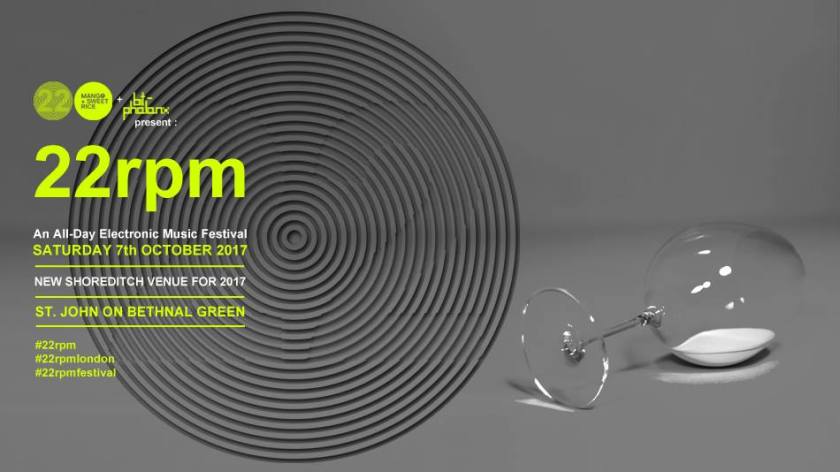
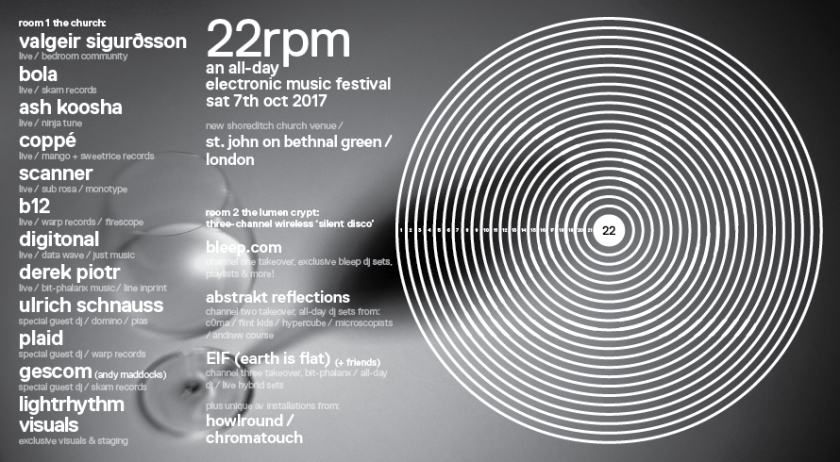
And lastly, news of next weekend’s 22rpm, a marathon all-day electronic music festival with a stellar line-up at St. John on Bethnal Green, a magnificent live music venue as well as a fully-functioning church, and the scene of Howlround’s recent live score of the film A Creak In Time. Headlining the Psyché Tropes event for the East End Film Festival back in the summer, that performance was memorable for the church kindly allowing us to use candle-stick holders as impromptu tape-loop restrainers (not the wisest of moves in hindsight) and for the moment when Daphne exploded. Perhaps mindful of these dramatic incidents, for this event the powers that be have banished us down to the crypt, where we’ll be creating an appropriately crepuscular and haunting soundtrack to counter the techno titans doing electronic battle over our heads. It is a seriously impressive line-up, have a look at this poster then click on the image to get tickets while you still can!
Hello, you. Compilation albums are like buses, aren’t they? You wait simply ages and then an unprecedented three of them turn up at once! Back in action after a couple of weeks recuperating from a busy summer, I’m now delighted to announce a trio of new and exclusive Howlround tracks, each part of an different long-player imminently about to drop on one of my favourite labels! Despite the pure coincidence of these three releases occurring within a few weeks of one another, the new works are actually about as varied and differing as our output has ever been, running the gamut from cold, dark ambience to armageddon operatics and back again. Further proof of just how easy it is to fall down rabbit holes then turn them into wormholes when you’re working with tape!
First off is ‘East Tower Stairwell Gathering (Alternate Edit)’, part of the double CD compilation Lessons from our friends at Front And Follow. To celebrate 10 years and an impressive 50 releases (including The Blow vol. 2, our 2016 split cassette with Time Attendant), the Manchester label is presenting a bumper 25 exclusive tracks across two discs, featuring the likes of Leyland Kirby, Pye Corner Audio, Kemper Norton, Ekoplekz and Laura Cannell to name but a few. Available for pre-order here, you can discover more by perusing this article from The Quietus and enjoying the video teaser below.
Next up is The Quietened Cosmologists, the latest release from A Year In The Country, adding to the impressive string of lovingly-crafted limited edition albums already under their belt, including Howlround’sTorridon Gate from 2014 (of which there are still a few CD copies left if you hurry). As part of this latest in their ongoing series of themed compilations, we’ve contributed ‘Night Call, Collect’, an ambient miniature inspired by a classic Ray Bradbury short story both in name and in its attempt to conjure up a both the foreboding dark expanses of deep space and the dwindling of humankind’s optimistic dreams of exploring them.
The Quietened Cosmologists is a reflection on space exploration projects that have been abandoned and/or that were never realised, of connected lost or imagined futures and dreams, the intrigue and sometimes melancholia of related derelict sites and technological remnants that lie scattered and forgotten. It takes as its initial starting points the shape of the future’s past via the discarded British space program of the 1950s to 1970s; the sometimes statuesque and startling derelict artifacts and infrastructure from the Soviet Union’s once far reaching space projects; the way in which manned spaceflight beyond Earth’s orbit/to the moon and the associated sense of a coming space age came to be largely put to one side after the 1969 to 1972 US Apollo flights.
It’s certainly one of the more glacial and sombre pieces in our recent back catalogue, but sits perfectly alongside exclusive work from the likes of Grey Frequency, Time Attendant (him again!), Polypores and Pulselovers. The album is released in October but will be available for for pre-order in the next few days, so why not whet your appetite with this playlist of teaser clips the label has put together?
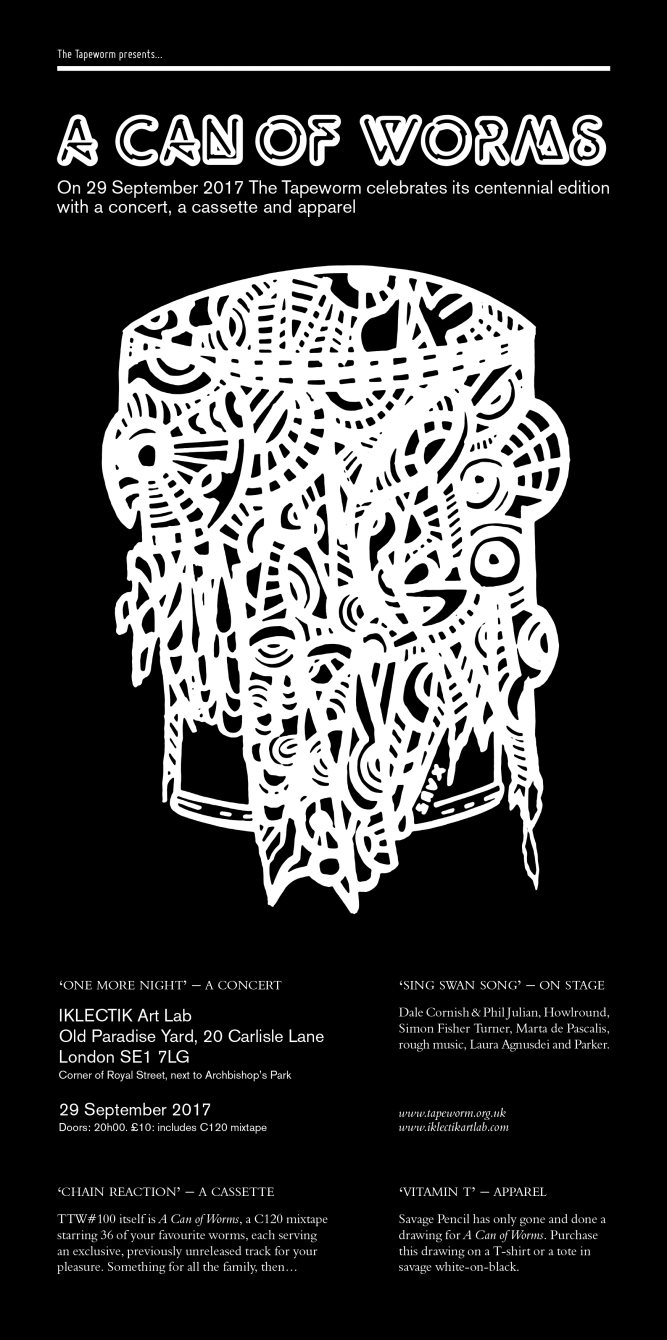
And finally, legendary cassette-only label The Tapeworm are celebrating their own landmark release with the unveiling of A Can Of Worms, its centennial edition featuring no less than 36 exclusive new pieces from label alumni such as Mark Van Hoen, Philip Marshall, Christian Vogel, John Butcher and many more; spread liberally across a limited edition C120 with cover artwork by Savage Pencil. Howlround contribute ‘Untitled (080417 Demo 4)’, a rather abrasive slice of distorted electronics that will hopefully offer some insight into a newer, noisier direction that I’m currently exploring and may even be the subject of a new LP early next year. But you might have to bear with me, this is one rabbit-hole I’m still digging…
A Can Of Worms will be released in a horribly limited edition of only 150 on 29th September, so the best way to ensure you bag a copy is to come along to the Tapeworm’s launch party taking place at Iklecktik that very evening. We’ll be doing a turn of the loops alongside album stars Dale Cornish & Phil Julian, Simon Fisher Turner, Marta de Pascalis, rough music, Laura Agnusdei and Parker, so it’s a pretty stellar line-up. Tickets come with a complimentary copy of the cassette and can be purchased here. Come hang out with some of ‘your favourite worms’ and help us raise a glass to the next hundred releases!
Hello you. It’s high time for an update on these pages following a breathless couple of weeks chasing tape loops around the countryside. I had very much intended to blog about all this excitement in real time, but that proved surprisingly difficult when in the middle of a field in deepest Oxfordshire or indeed some forty metres below another field in equally-deepest Essex. Add to that the three cups of Wetherspoons coffee I’ve just imbibed in order to justify using their appallingly faltering wifi and it’s a wonder I’m managing to type anything at all!
Follow @chameleonic on Twitter
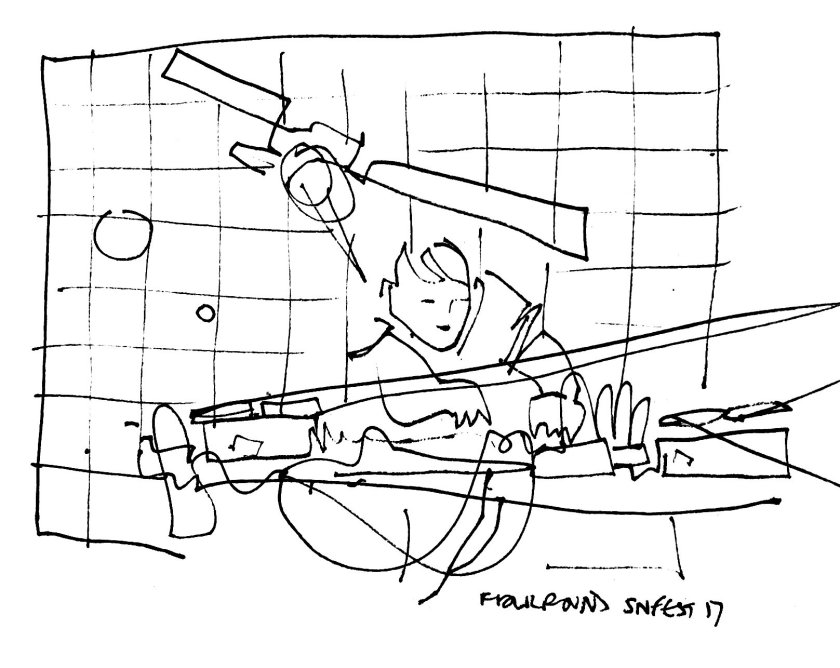
Anyway, to kick off this mini retrospective, here’s an extract from Howlround’s performance at Supernormal from Friday night, where we rocked the Vortex Stage as the proud filling in a Teleplasmiste and Unica Zurn sandwich. Thanks to Mark Pilkington, sound engineer Jimmy, plus Steve and Janine from Psyche Tropes (and not just for the supplying birthday-related espresso martinis the following morning!). Special thanks must to also go to Nic Finch for these splendid illustrations of Howlround in action, which I discovered the following day pinned to various surfaces all around the festival site. Check out more of Nic’s work here. There was a very complimentary review of the festival in CCQ Magazine (appearing on their site a great deal quicker than this one), which described Howlround as ‘easily the highlight of Friday’, an incredible accolade when you consider the evening was headlined by Wolf Eyes!
The sounds are deep, part natural, part industrial, making me think of a neverending uninterrupted series of tube and train journeys, taken alone; eerie and disconcerting, flashed through with the clacking of the tape reels. CCQ Mag
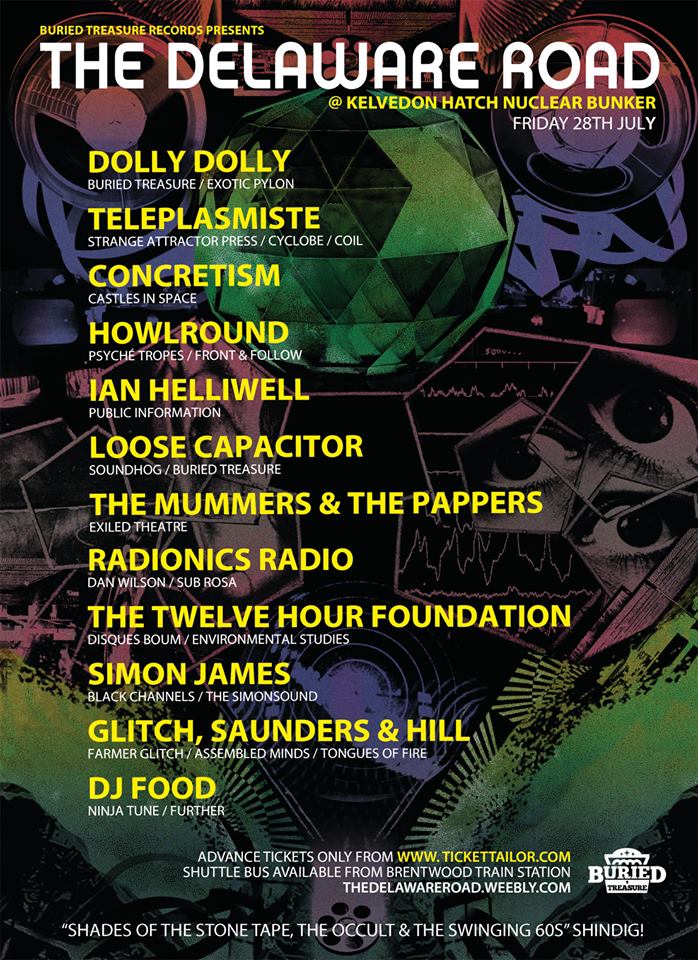
The previous Friday night had also been a hive of activity as the long-awaited Delaware Road event at Kelvdeon Hatch ‘Secret’ Nuclear Bunker finally came to pass. An audio-visual, multi-sensory experience months in preparation, meticulously planned and taking over the entire complex of operations rooms, dormitories, offices and sick bays with a psychedelic extravaganza of sound and image buried deep within a remote Essex hillside. Featuring performances by Howlround, Teleplasmiste (them again!), Loose Capacitor, Twelve Hour Foundation, Simon James, DJ Food, Radionics Radio and many more. The results were nothing short of a triumph, with the bunker completely sold out and packed to the rafters with revellers excitedly exploring the surroundings. People talk a lot about events being ‘immersive’ these days, but with strange sounds and images penetrating ever corner of this most shadowy relic of all-too-recent history, and with the Churchill-like figure of Dolly Dolly at the helm to tie all the strands together; I’m convinced that a new standard has been set!
This slideshow requires JavaScript.
Photography by Pete Woodhead
Howlround’s own performance consisted of a three hour installation in the Telex Room next to the radio studio, with a film programme by Psyche Tropes taking place next door – perhaps the one place in the entire complex where I could envision feeling slightly at home in the event of armageddon. As you can see from the pictures, the installation, including assistance provided by two wordless (and armless) volunteers in black cowls made for a suitably eye-catching affair, captured here in the photographs of Pete Woodhead (colour) and Victoria Hastings (b/w). A big thank you to them both, and there’s plenty more of their photos (and those of others) to be admired by visiting The Delaware Road’s Facebook page.
This slideshow requires JavaScript.
Photography by Victoria Hastings
One downside to having to remain in the Telex room and keep a close eye and a firm hand on my semi-trusty machines and two wordless assistants for the duration of the event, was being sadly unable to take in any of the other performances, all of which were designed to occur simultaneously and to last for the duration of the event; providing the audience with a veritable smorgasbord of the uncanny at every turn. However, the information gained second-hand through reports and feedback from revellers constantly passing and re-passing through for their hit of tape loop action assures me that there were no shortage of memorable moments. One person who was afforded a more rounded perspective of the event was DJ Food, who used the time between his sets to take in some of the performances going on around the site and engage in a spot of mingling. The resulting review on his own blog is – as ever – worth a read.
This slideshow requires JavaScript.
Photography by Pete Woodhead
That’s me on the right, pulling sinister faces with David from Loose Capacitor. Photo by Victoria Hastings
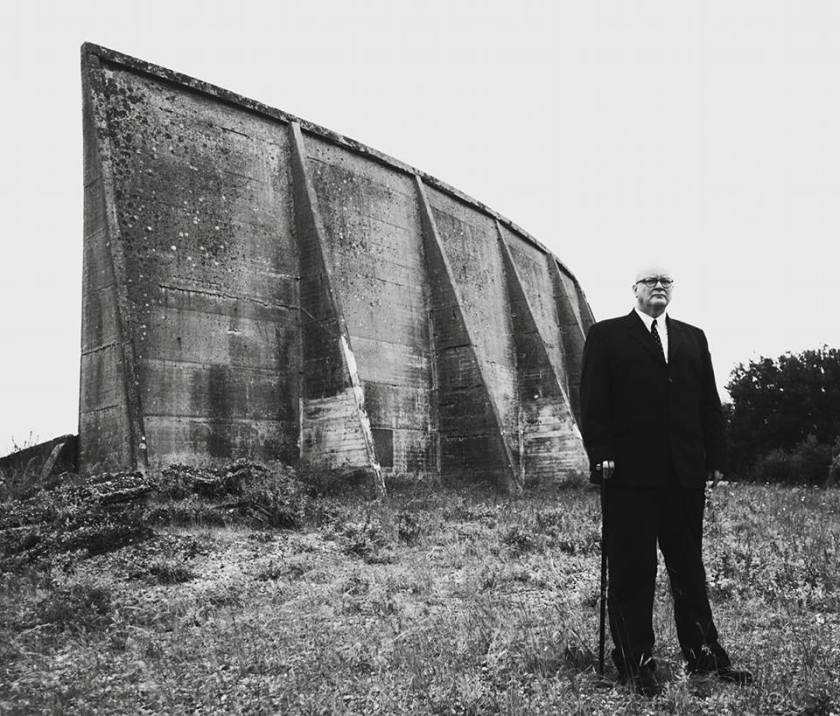
In short, one of the most memorable nights of 2017 and certainly one of the most remarkable venues Howlround have played thus far, an increasingly crowded field when you take all of our cemeteries, water tanks, reservoirs and Victorian engineering shafts into account. A tribute to the ever-growing Delaware Road story, the community of artists, musicians, DJs, nerds and weirdos that have grown around it, and the tireless imagination of the brains behind it all, Buried Treasure Records boss Mr. Alan Gubby. Can’t wait to see where he’s taking us next, though I expect he’ll probably want a cup of tea and a sit down first. In the meantime, make sure you pick up a copy of the self-titled debut LP by his group Revbjelde, another personal highlight of 2017.
Revbjelde – a slice of weird albionBest Bud: Delaware lynchpin and chief strategist Alan Gubby keeps things in order.
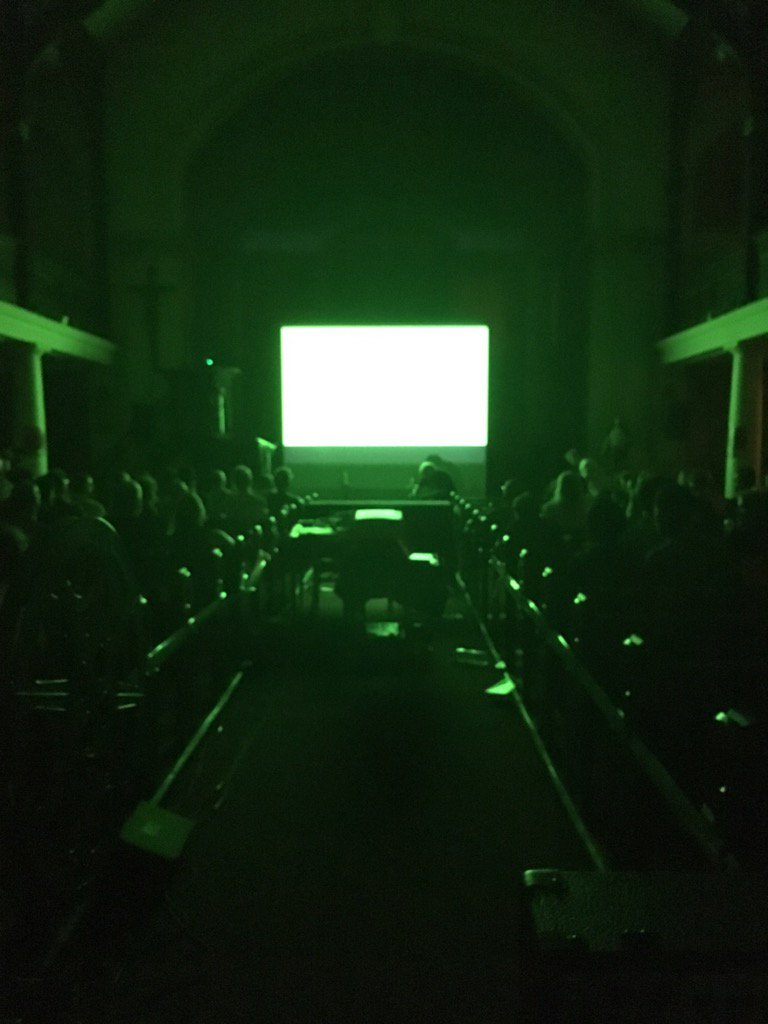
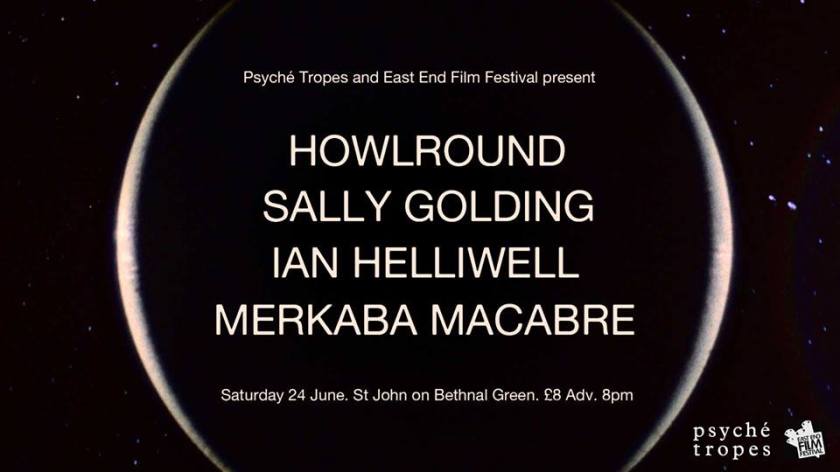
Finally, a quick mention of another 2017 highlight, Howlround’s recent headlining of the Psyche Tropes event at St John on Bethnal Green as part of the East End Film Festival, where we performed a live score of A Creak In Time, our film produced in collaboration with director Steve McInerney (and still available on heavyweight vinyl with streaming and download here). That performance and the event in question, featuring performances Sally Golding, Spatial, Ian Helliwell and Steve’s own Merkaba Macabre project, are the subject of a very flattering review in the latest edition of the The Wire, available now from all good outlets. Thanks to Katrina Dixon and again to all at St John for having us – hope we didn’t do too much damage to the candlesticks by using them as loop restraints?* They only fell over a few times, after all. Rumour has it we’ll be returning to the church in some shape or form come the autumn. But more on that later…
As the sound shreds and fades, it leaves behind a cosmic wow to take out into the night – is this the sound and feel of being sucked into a black hole? Katrina Dixon, The Wire.
*To clarify, we did get permission to use the candlesticks first. I would hate anyone to think we would take any liturgical liberties!
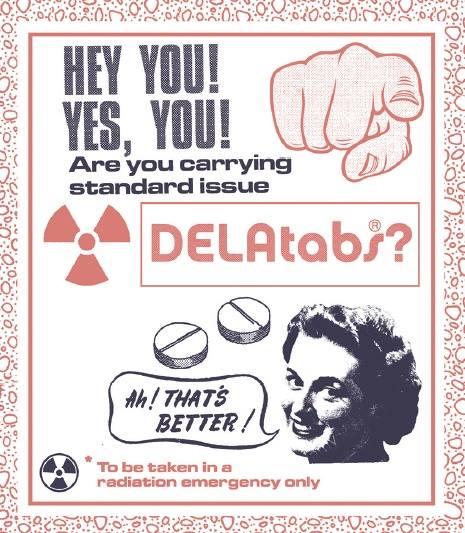
One final push for all mankind: After months of preparation The Delaware Road’s fully-immersive audio-visual seance finally takes place this Friday 28th July at Kelvedon Hatch Secret Nuclear Bunker, with the last few remaining tickets now released and selling fast. ‘Immersive’ is a bit of a buzz-word these days, isn’t it? Well, rest assured that henceforth nobody will have license to use it ever again unless they too are planning an extensive “occult conspiracy thriller [and] audio-visual treat for fans of archived electronica, far out jazz and haunted folk grooves chronicling [an] obsession with sound, sex & magic” deep beneath a hillside somewhere in Essex, complete with live performances, sound installations, film screenings, fully stocked bar, map, emergency pack of ‘Delatabs’ and a lordly yet slightly terrifying host in the shape of one Dolly Dolly.
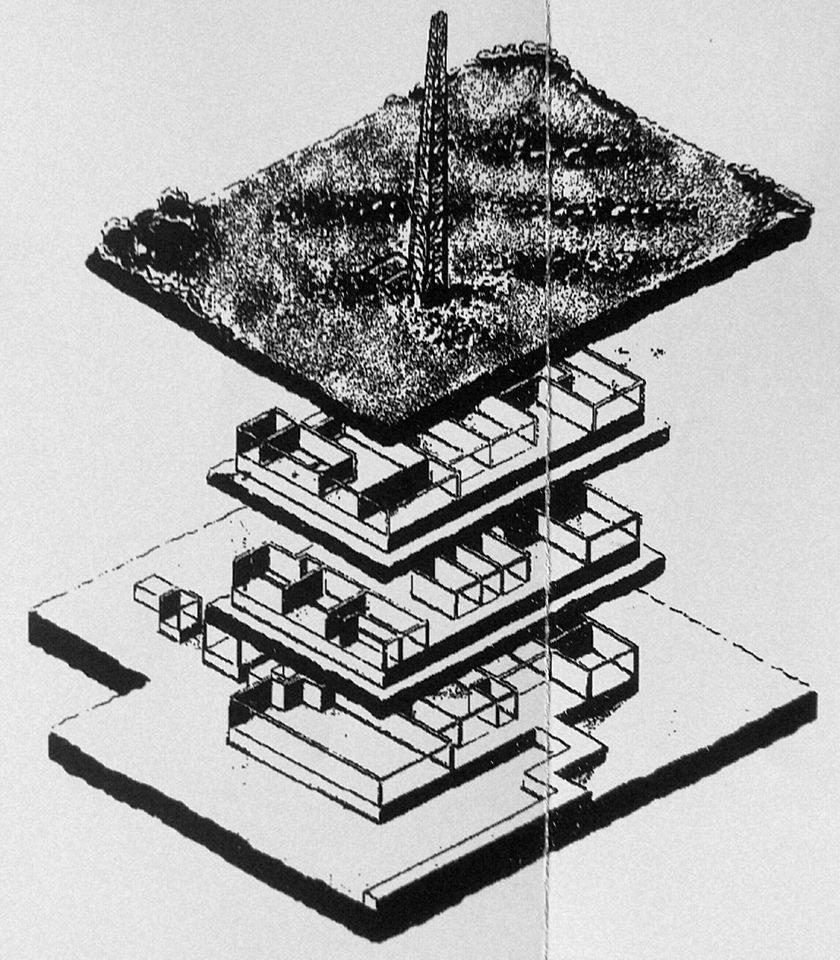
Howlround are going to be engaged in a three-hour tape loop installation in the Telex Room, where we’re hoping to conjure up some sound, sex and magic of our own, so do pop over, but try not to become entangled up in our cats cradle of loops. Of course that’s only one corner of the bunker and the event is designed to make full use of this most remarkable of locations, with performances, installations and screenings taking place continuously in chambers and secret spaces all over the complex; encouraging the audience to fully explore this remarkable facility. Preserved exactly as it was at the height of the cold war, Kelvedon Hatch was designed to house the government in the event of armageddon, and had it ever been used ‘in anger’ would have sheltered six hundred people from nuclear winter for a year or more. They would’ve envied the dead within a week. Thankfully your tickets also guarantee your safe departure.
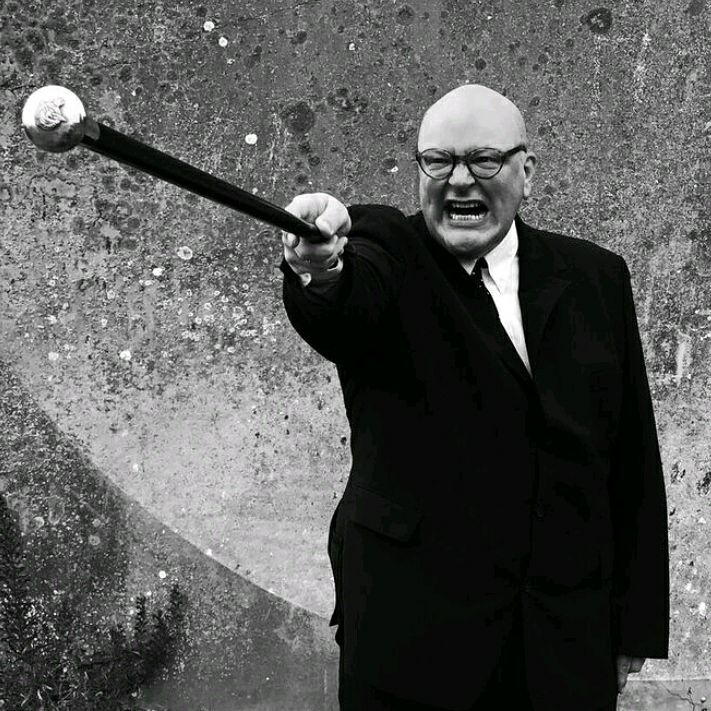
He’s a pussycat really. Just don’t call him a hauntologist!
‘A simple title, but it makes the purpose of this concert clear. The aim is to raise a substantial amount of money to donate to charities and groups supporting the victims of the Grenfell Tower disaster. The artists participating are from a diversity of musical genres, they are united by their singular talents and an unswerving commitment to their art’.
MATINEE CONCERT (2pm – 4pm)
Adam Bohman Pat Thomas Keiko Kitamura Beatrice Dillon (DJ set)
EVENING CONCERT (7.30pm – midnight)
Howlround Aisha Orazbayeva Kuljit Bhamra Lee Gamble (DJ set) Clive Graham of Paradigm Discs (DJ set) Shadow Justice Crew (DJ set)
There are no advance tickets for each events, so just show up. There is a recommended donation of £10 on the door. Minimum Donation £5 on the door. Free entry for Grenfell Tower residents, firefighters and NHS medical staff.
This event is produced by Richard Thomas with the assistance and support of Fielding Hope and the team at Cafe Oto, Resonance FM and The Wire. Special thanks to Ed Baxter and Jennifer Lucy-Allan.’
Howlround are delighted to be playing at this most esteemed of festivals this Saturday, 8th July alongside Steven McInerney, Pascal Savy and Janek Schaefer! See you there!
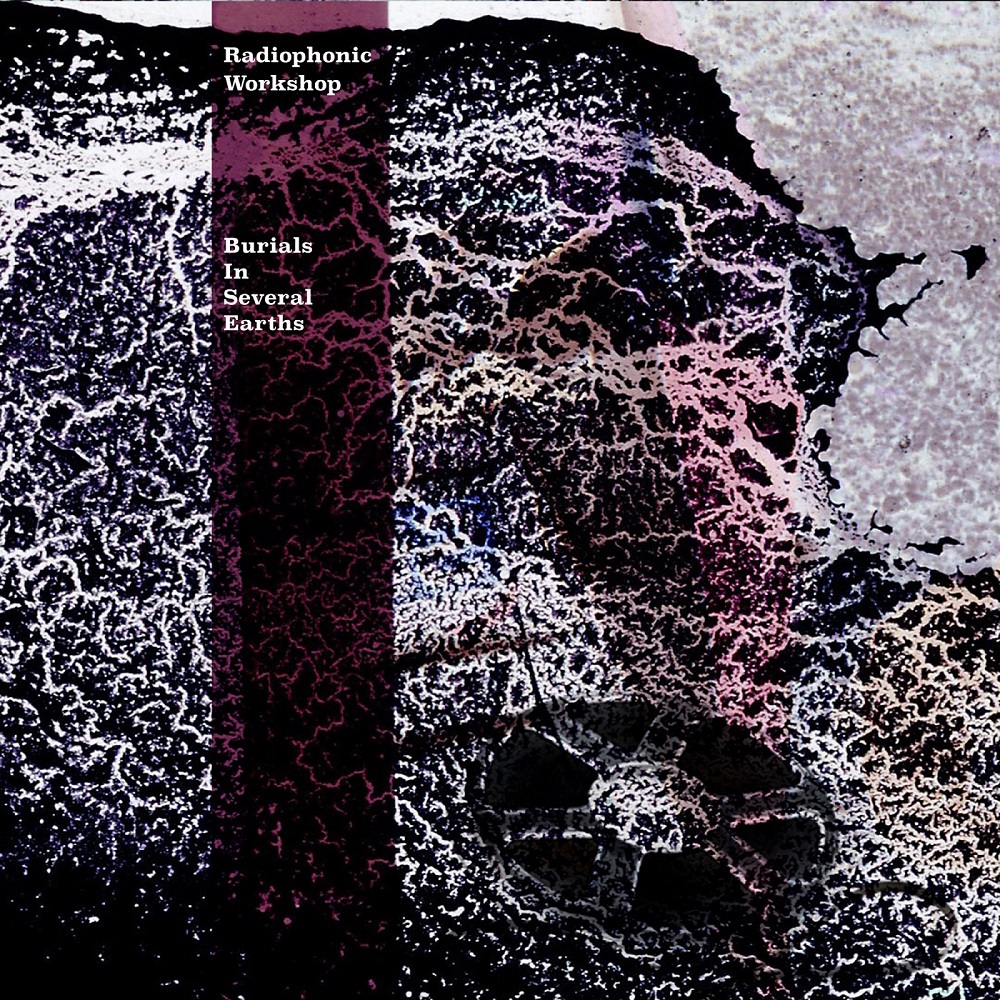
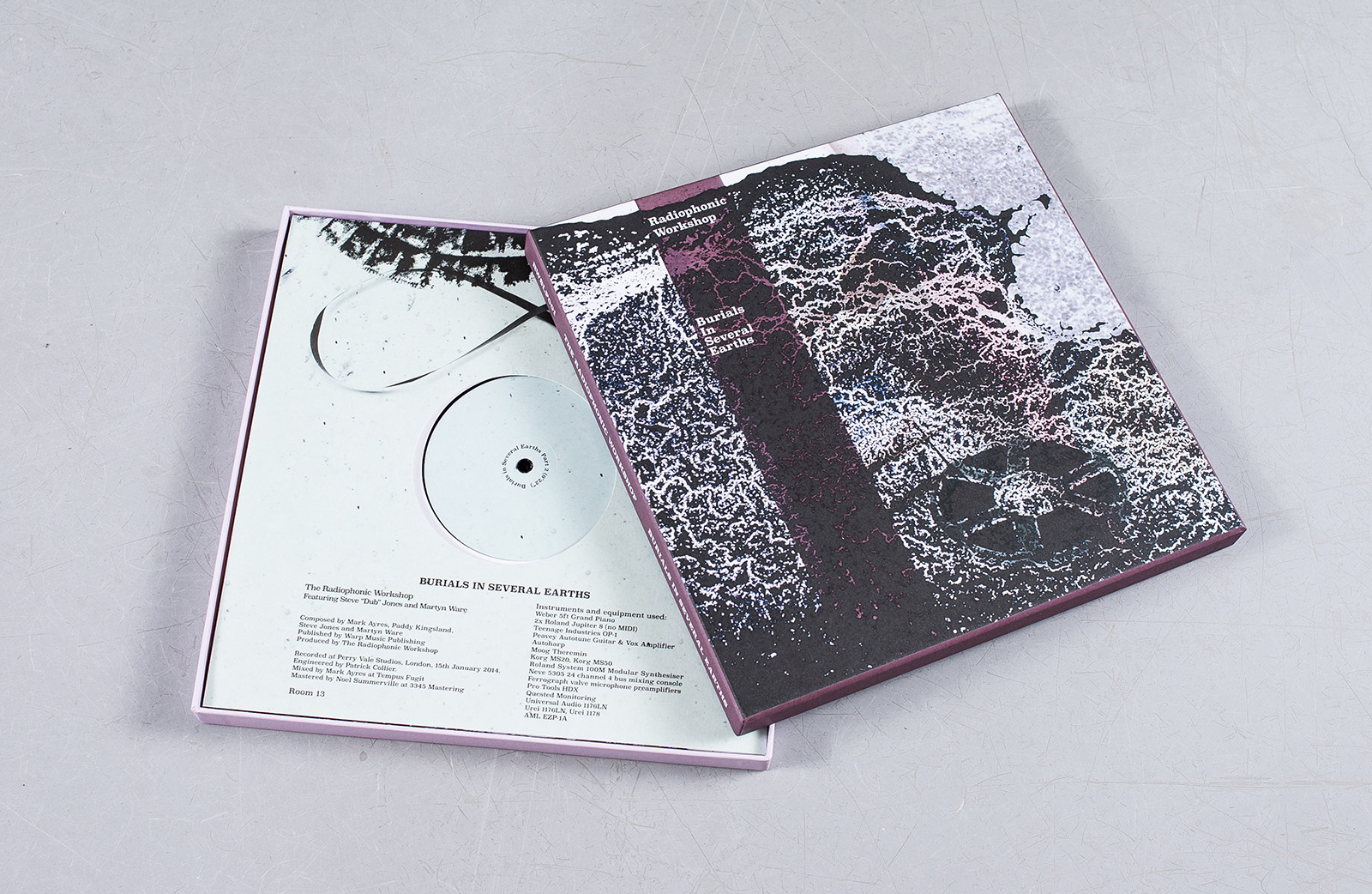
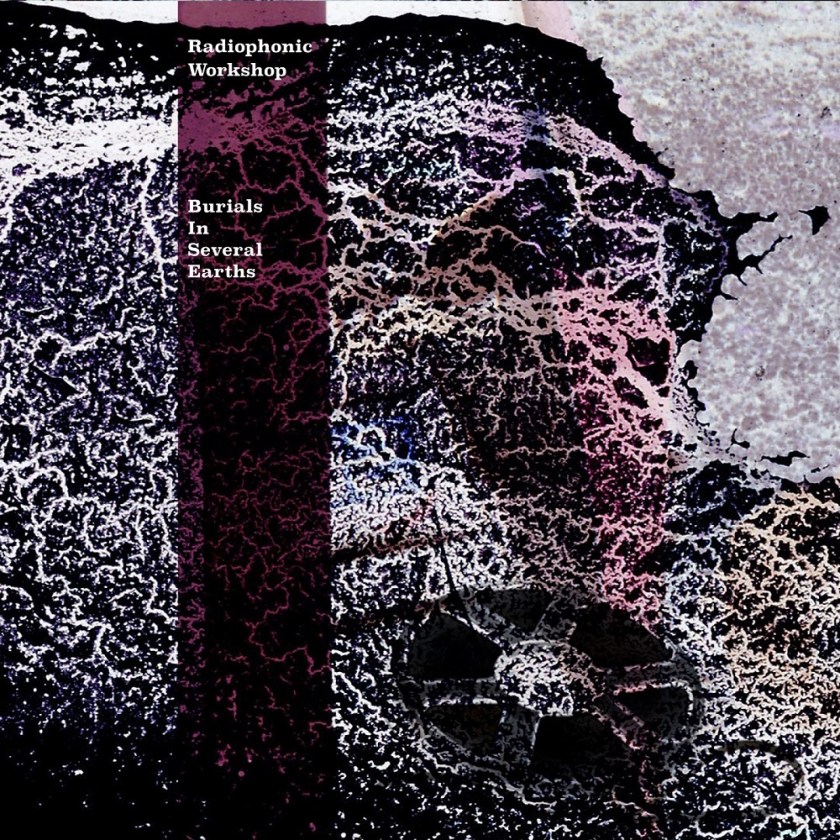
Here at last is the transcript of my encounter from a couple of weeks ago with a quartet of members from the reformed Radiophonic Workshop, recorded while gathering material for the above BBC report on their first album of new material in over thirty years. Burials In Several Earths comprises an extended set of drifting, ambient excursions crafted from hours of playing and improvising together as a group and is now available as a lavishly packaged vinyl boxset with beautiful artwork – or a double CD version if you’re particularly into retro technology.
Ahead of their recent show at London’s Science Museum, I tracked them down at a secret rehearsal studio somewhere just outside of London, a small building near a busy railway line, crammed with an eye-watering amount of vintage analogue equipment that remained frustratingly silent throughout, due to an ongoing and pervasive technical problem that the band were trying to unpick. I arrived to find Paddy Kingsland (‘a couple of keyboards, an autoharp from the 50s with all the guts ripped out of it, computer and guitar’) on the phone to some sort of technical support helpline, while Peter Howell (keyboard, guitar and wind controller), Roger Limb – (keyboards and a U-Bass ‘which often raises people eyebrows – it’s a bass but not much bigger than a ukelele’) and more recent member, Workshop archivist and de facto bandleader Mark Ayres (‘surrounded by more synthesisers that is probably legal and a Macintosh computer and various gadgets’) all offered suggestions and scratched their heads. It seems that even several decades at the cutting edge of technology can’t prevent the odd hitch now and again. Their loss was my gain, however, as it gave them an enforced break in which to answer my questions, interrupted only by the remarkable squeaking sounds coming from Roger’s chair and the occasional passing express…
[Sudden sound of train siren]
Mark – Your next album there, Robin!
Have you ever had Steam Railroading Under Thundering Skies? A fantastic record, it’s literally old recordings of western trains in the US and thunder and rain and that’s all it is! It’s beautiful, no manipulation or anything, just those sounds!
Peter – You go to all this trouble to make this special sound and then the natural stuff sounds great! […] I was over in the Canary Islands on holiday and the exit ramp of the ferry that lets the cars on was moving to and fro because of the movement of the ship and the sound was brilliant! So I recorded it and put it through [synthesis app] Metasynth and there is a whole piece to be derived from those sounds, they were all harmonics of metal squeaks [vocally imitates this to his best ability] – a brilliant sound! Jane thought I was completely mad. I said ‘that is amazing’, she said ‘Amazing? It sounds bloody awful!’ [laughs]
Mark – One man’s bloody awful is someone else’s art!
Roger – In Maida Vale there were some good wind noises. There was, what was it, the door to the ladies?
Peter – I made a Fairlight sample out of it! I called it door wind. It sounded like a soprano! The most incredible sound!
Roger – Well, it did come from the ladies loo!
[Brief interlude while Paddy receives another phonecall from tech support and I record the sound of Roger’s squeaking chair, which was becoming such an intrusive presence that it was deemed prudent to make use of it – ‘when in Rome’ etc.]
So, Burials In Several Earths, a brand new album and the first release of new Workshop material in over three decades. Could we start by talking about where the title comes from?
Mark – There was a quote from [Francis Bacon’s 17th century utopian novel] New Atlantis pinned on the Radiophonic Workshop wall in the early days, Daphne Oram put it up – ‘we also have sound houses…’ I was mixing the record and I had no idea what the titles were [going to be], because it was pure improvisation. And I thought that New Atlantis might be an interesting benchmark, so I sat down and read it one evening and if any interesting phrase that might be a track title jumped out at me I made a note of it. I ended up with about 20 possible track titles and I went through them and I thought ‘okay “burials in several earths” that works for that, “things buried in water”, that works for that’. So that’s how the tracks got their titles. It was not inspired [directly] by New Atlantis but the titles came from it – and they fit pretty well.
Workshop co-founder Daphne Oram
Could we talk a little bit about the album’s gestation? In the old days obviously, composers at the Workshop would work to commissions and deadlines, whereas this is more communal and improvised in nature.
Paddy – It’s hugely difficult for us to work without a deadline because we’re so used to it and so used to somebody saying ‘well, we need this amount of music and it’s got to be this kind of thing’ – happy, sad, horrific, whatever it is – ‘in a certain time’. Without that deadline it’s quite difficult to get started on something! [So] when we had the opportunity to just experiment in another studio, not one that we were operating all the equipment in, we kind of jumped at that chance! It happened that we were working with other people as well and so it was all the more exciting. We had Martyn Ware [ex-Human League / British Electric Foundation / Heaven 17 plus a LOT more] and also Steve ‘Dub’ Jones of Chemical Brothers engineering/production frame, so quite good people working with us and we didn’t have any kind of preconceptions about what we were going to do. We just played for an entire day and came up with, I don’t know how many hours it was, but lots of material; which then Mark spent time going through and selecting bits and putting them all together. It made it a lot easier to come up with ideas and bounce off each other – a bit like improvisation except that we were more or less improvising with sounds rather than perhaps [just] the music side of things. So simultaneously trying different sounds out with each other as well as coming up with chords and all of that.
Mark – We usually work individually as media composers or whatever when we’re doing commissions. All these guys had their own individual studios [at the Workshop]. When we did our first concert at the Roundhouse a few years ago, I remember Peter and Paddy taking themselves off to work out the chords and voicings for Doctor Who. We left them alone for about half an hour and suddenly we could hear this chuckling and we went back and they said ‘do you know we’ve never actually done this’! They were doing the Lennon and McCartney thing, sitting opposite one another with their guitars and they’ve never done that before in their lives! This is a whole new phase, the first time we’ve all come together and worked together and so one of the things we did was that we teamed up with various groups of other people to see what would happen. So we’ve worked with various people like GhostPoet and in this particular session we were set up with Martin and Steve – and it was just fill the room with synthesisers and see what happens. And that’s a whole new way of working! Paddy and Roger have done a thing with Tom Middleton so there is a whole lot of that stuff as well which may come out one day. Roger and I have been working with Paul Hartnoll from Orbital, Peter and I did a session with Phil Manzanera, so we got all this stuff in the bag now and we just working out quite what to do with it going forward. But it’s very exciting, little groups of us getting together and not knowing what’s going to come out of this. Normally if you’re going to one of these things you try and turn up with a little bit of an idea in the back of your head. This one we didn’t. We all looked at each other and said, well, what do we do? So we all started fiddling and after about two minutes I waved through the glass and said ‘you’d better start recording’ because interesting things were starting to happen. And that’s what we did.
Very different from the traditional working to a strict brief or set of parameters, of course!
Roger – [finally abandoning his noisy chair] My view on this is that when we were working on commissions, the deadline was often quite frantic and sometimes you’d arrive at a place and say ‘oh, I wish I could explore down that passage, that path a little bit more because that was an interesting collection of sounds or an interesting way of working, but quite often you didn’t have time. At least this way we found or at least I’ve found that you can experiment more and spend time – time is always precious – but we’ve less constraint than there used to be and that’s quite an interesting way of working that we that we’ve discovered now rather than when we were actually at the [original] Radiophonic Workshop.
Roger, your background is as a jazz musician of course. So you must be quite used to improvising?
Roger – Well, I still do lots of jazz gigs and the thing is I’ve been doing jazz gigs since I was 15, I suppose. And other things – [for example] I’ve conducted choral unions! The thing about being a musician is if you’re lucky enough to do things in different fields, nothing is wasted. Though I might conduct the Messiah, I think the experiences I had playing jazz in Ronnie Scotts is [also] part of the background, if you see what I mean. As I said, nothing is wasted, there is a lot of music rattling around in my head and sometimes one compartment overlaps with another one.
Paddy – Desmond Briscoe who started up the Workshop with Daphne Oram used to say ‘you’ve got to fail sometimes, you can’t succeed all the time’. And if you have room to fail, you’re not frightened of failing; you eventually come up with something quite good! So working in that way, we didn’t mind if we made mistakes or started again, because we had that room to experiment properly. You’re not going to get anything good out of it if you play it safe all the time! The good stuff comes out when you’re on the brink of failure!
I often think wrong is actually just a version of right that maybe hasn’t been taken into account yet!
Paddy – The happy accident! It’s what a lot of our catalogue is based on!
Peter – Entire careers are based on serendipity! But going back to what Roger was saying, the fact that when you’re working to a deadline you don’t have time to take things to their logical conclusion. I remember several occasions when I got terribly involved with doing something, [but] the actual project or commission I was working on was not a very big one, it was only twenty seconds opening [music] or something like that. I got so involved in what I was doing and so intensely into it that I took the decision that it was far too good for them and they weren’t going to have it! [laughs] And so I actually put those tapes away, which was an hour and a half of development that I’d been doing and then had to think of something else for the twenty seconds! The sad thing is that those tapes don’t come to anything when you’re working for the BBC in the [original] Workshop, whereas nowadays those recordings would come to something and [this] album is an example of that of one of those things. It’s an extension of a long-form idea that’s taken to a logical conclusion, one that would not of been possible in the old days.
The next level – a continuation, then? To me it’s a lot more ambient and drifting in nature, compared to the older releases.
Mark – A lot of the early sound effects which Delia [Derbyshire] and Dick Mills did – Dick Mills was master of the ambient sound effects for Doctor Who and various other shows – a lot of it was ambient. We’ve been doing lots of different things, I mean there are six of us in the band we’ve been doing different things in little groupings and side projects and things and seeing what comes out really; and this was the first one which came together. But yes, people have said to me it wasn’t what they expected, some people thought they were going to get something more like The Fourth Dimension, which was Paddy’s album; some people thought it was going to be like Through A Glass Darkly, which is Peter’s album – piano, synths and guitar. I think the fact that it’s not what anyone was expecting is probably quite a good thing! And yes it is very ambient – the tracks end because that’s where we stopped and had a cup of tea. That’s the way we did it – we waffled on for half an hour and then we all thought well, that’s enough of that! In fact on the end of ‘Not come to light’, which is the shortest track on the album, if you listen very carefully you can hear people talking in the background. It’s lost in the reverb but what we’re actually saying is ‘that’s quite enough of that – put the kettle on!’ And that’s the way the album came together and I just thought it was fun to leave that in. Because it’s a little bit of a little part of the creative progress, what’s going on in the background.
Peter – We are working on lots of other new stuff that falls more into the category of individual tracks and is less extended and so harks back a little bit to more thematic content. So we’re able at long last now we are in the present situation of choosing what sort of things we do, and it’s really nice to have a bigger pallet at your disposal.
Mark – If you look at the [older] Radiophonic Workshop albums like 21 or The Soundhouse, there’s [solo] tracks by Paddy, by Roger, by Peter, by Elisabeth [Parker] et cetera, so we do have individual tracks. Our live set is built up of tracks that with we’ve each written, that we then bring to the band and work up as a performance. So everything we do is slightly different from the way that the Radiophonic Workshop traditionally worked. We’ve got the side projects, we’ve got the full band stuff that we doing – we’ve got about five projects in our back pocket, the question is finishing them to be honest and getting them out there!
Peter – That’s the trouble I especially have – finishing things! I love new things, but it’s not all positive because the negative side of it is that you never finish anything! I think [it even helps] having the deadline of a concert. We’ve got a concert coming up in July and I’ve written a new track for it and it’s been a really good discipline because I know I’ve got to get it all sorted by then, otherwise it [just] would’ve drifted on. So it’s still valuable to have deadlines!
Mark – And then he’ll be disciplining us because we’ve got to learn it!
Paddy – We’ve met with a lot of popularity and I think people seem to like [our work] very much and they’re very interested in it, but I think the reason they’re interested in it is because of those wonderful people like Delia Derbyshire and John Baker who came before us – and also we worked with them – and people like Brian Hodgson. We are standing on their shoulders, really, because they started it all and formulated all this kind of way of working. We are reaping the benefits and having people coming in and enjoying it, [but] we should say a word for them too, I think!
This brings me quite next nearly to my next question. Obviously many of those original Radiophonic staffers such as Delia Derbyshire, John Baker, Daphne Oram and others have now passed on. What do you think they would have made of all this?
Paddy – They’d laugh!
Would they want to join the band as well, do you think?
Roger – We’ve often thought of that, actually, what would Delia make of all this? I think because she was such a feisty lady, she probably would quite enjoy the idea. I don’t think she would come up on stage and do anything, but she would be very happy for us, I think. John Baker, he was a bit of a jazz musician as well, he went and did a few jazz gigs. I don’t know that he’d enjoy playing with us on stage, perhaps he would. I don’t know whether he had the overall, shall we say, arching ambition or discipline to do what we’re doing and of course he was quite a bit older than us. We’re old enough but he was at least 5 to 10 years older!
Roger – It is, but it’s very much inward-looking if you know what I mean – it was just him and his tape machines and a studio. But certainly disciplined – he was obsessed, driven by it if you like and like a lot of [these] people probably close to genius. He certainly set the trend and made some wonderful stuff, but of course the main problem was – and we’ve talked about this many times – the techniques of the Workshop changed at the beginning of the 1970s and the whole business of tape cutting became less used. We went on to synths and multitrack working and eventually sequencing and digital recording, so [first wave members such as Delia and John] were not there at that time. I don’t know – they probably would quite enjoy using [these newer techniques] but it wasn’t their scene at the time.
Mark – It is interesting that the Workshop’s history does range from the early tape music experiments through to the theme tunes and all those sort of concept albums like Through A Glass Darkly and things like that – a real gamut of musical taste and technique. And that’s what we try and bring to what we do now. We don’t do the full performance art tape music because a lot of people that come to see our gigs want to hear the ‘Astronauts Theme’ or ‘Hitchhikers Guide’ or of course ‘Doctor Who’.
Peter – I tell you what they also like to see – an inordinate amount of gear on stage, which we’re standing in the middle of at this second and has taken us about three or four hours to set up! I’m glad to say we don’t take that long when we do festivals, but I think we want to put ourselves apart from those bands that are very, very sparse when you go and see them and [when] there is very little on stage. We are quite the reverse because I think people like to see the gear and they know it’s all being played live and an enormous amount of what we do is live. So I hope they’re getting their money’s worth!
‘A band that never was’ – The Radiophonic Workshop in 2017
The Radiophonic Workshop have inspired a lot of electronic music over the years, with artists such as Aphex Twin and Orbital naturally springing to mind. So I’m wondering if any modern musicians and producers have influenced you?
Mark – I think we’re all inspired by what goes on around us. I’m of the generation of Aphex Twin and Orbital, I am of that generation inspired by these guys who I’m now having this great pleasure of working with. I get people coming up to me at seminars and saying I listened to your Doctor Who music in the 80s and that’s why I’m doing what I’m doing now, which is exactly what I was saying to these guys and to Dudley Simpson 20 or 30 years ago! So it just keeps on going and that’s great.
Roger – I’ve always enjoyed listening to Brian Eno’s music. He’s a wonderful genius. Though I go back to Joe Meek! I actually worked with Joe Meek in the early 60s, he showed us round his studio and his bathroom echo chamber and this wonderful machine that he played ‘Telstar’ on, so I do go back that far. I wouldn’t say that I wanted to copy or emulate him in any particular way, but I did feel I was stepping inside a little bit of history for a few days!
Mark – There is some amazing stuff out there. There are still people doing musique concréte and tape music and some fantastic experimentation. Brian Hodgson, Dick Mills and I were up at Delia Derbyshire Day over the weekend and they had loads of kids and adults coming in and doing workshops on how to put [sounds] together. Nowadays if you got a mobile phone with GarageBand on it you can do the kind of stuff that was being done back in the 60s and 70s and beyond, not using the exact same techniques but using digital facsimiles of those techniques. You can record sound, you can play with sounds and if like us you think there is music in everything from a squeaky chair to a trombone or a string orchestra or anything, if you hear music everywhere you can go out and you can make that music. Why not? Do it!
Delia Derbyshire
Going back to artists such as Orbital, I was recently attempting to explain the Workshop’s effect on the history of electronic music to some students by using a clip of that duo performing their amped-up version of the Dr. Who theme at Glastonbury festival from a few years back. Every time I watch that clip, I wonder what Delia would have made of their version. Would she have chided them or would she have been delighted to hear it and to see several thousand people dancing to something she’d had a hand in?
Peter – I don’t know that Delia would worry really because let’s face it she was doing a version of something written by Ron Grainer. And somebody who’s done a version of somebody else’s composition isn’t likely to worry if somebody else does a version [as well]! In fact Delia actually heard my version of the Doctor Who theme and she was very generous about it and she wasn’t at all upset that hers had been changed into mine, it was just a matter of moving with the times. No, I don’t think she’d worry, actually, I think should be quite excited about it!
Mark – Delia did say that your version of the Doctor Who theme was closer to the score than hers was. And she was very complimentary about [it]. She did write a letter of complaint to the BBC about one of the later versions, though!
Peter – Did she really? I didn’t know that!
Mark – She was in two minds about all sorts of things!
Roger – She was very down to earth person underneath. We think of her as all these wonderful ethereal sounds and she went around in flowing robes from time to time, but she was very down-to-earth really, wasn’t she?
Mark – Delia was a mathematician [as well as] a musician and she did sit with a book of log tables next to the desk to work out crescendos and diminuendos and all that kind of stuff. And tape cutting you know when a crotchet was 15 inches and a quaver was 7 1/2 inches – that was maths and they had to work all that out back then. We’ve kind of moved beyond that in terms of synthesisers and things, but Delia was well into working out the harmonic series, she was very mathematical the way she worked, but that’s not quite so necessary these days. Techniques have moved on!
And with that, I thought I’d better let them get back to untangling their technical issues. I was sadly unable to attend the Science Museum show that followed a few days later, but I’m told it was a great success, so can only assume the problem was fixed and they were able to keep those techniques moving. Either way, Burials In Several Earths is out now and The Radiophonic Workshop look set to be unveiling quite a few more surprises in the coming months. Follow their activities here and here. Of course, a notable holiday-enforced absence from all of the above was amiable raconteur Dick Mills – the longest-serving member who also serves master of ceremonies during the group’s live performances – who was spending quality time with the Grandchildren that week. However, I did manage to catch up with this most affable and engaging member of the Workshop’s ‘first wave’ at the recent Delia Derbyshire Day in Manchester and will hopefully be bringing the fruits of that encounter to these pages soon. Though I’ll be needing a strong coffee before I have a crack at transcription and might have to publish in instalments! ‘Once you get him going’, etc. etc…
For those of you who missed it, here’s a clip of Howlround on stage at Further last month, debuting the live tape loop score to to A Creak In Time:
….And if you were one of those unfortunates who did miss it, I’m sure you’ll be delighted to know that we’re going to be doing it again this weekend in Bethnal Green as part of the East End Film Festival, alongside a star-studded line-up curated by the Psyche Tropes label. It’s on Saturday evening at St. Johns and further information can be found either on the Festival’s website or the event’s Facebook page here. See you there!
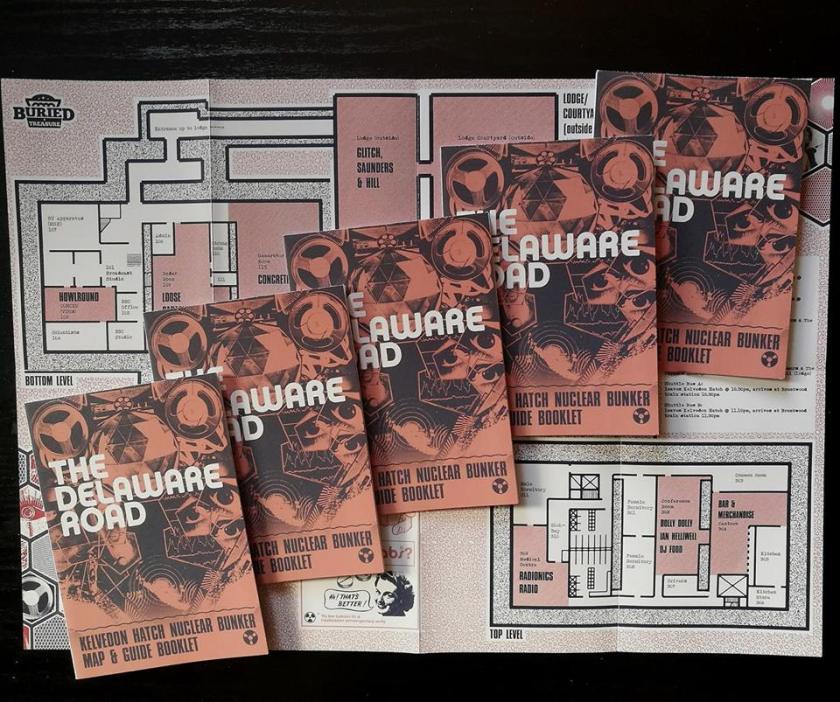
In other live news, there’s just over a month to go before The Delaware Road, the immersive audio-visual extravaganza that’s set to take over the labyrinthine subterranean environs of the ‘Secret’ Nuclear Bunker at Kelvedon Hatch, a maze of corridors, offices and operations rooms deep beneath the Essex countryside. So labyrinthine, in fact, that chief strategist Alan Gubby, the man behind it all, has deemed it prudent to produce some maps of the venue in order to avoid, say, visitors to the event accidentally stumbling into two shadowy figures inside the bunker’s radio studio, engaged in some kind of obscure ritual conjuring up the voices of the dead. For three hours. While wearing robes. Haven’t managed to get my hands on one yet, but I must say they look decidedly spiffy if this publicity photo is anything to go by. Have you got your tickets yet?
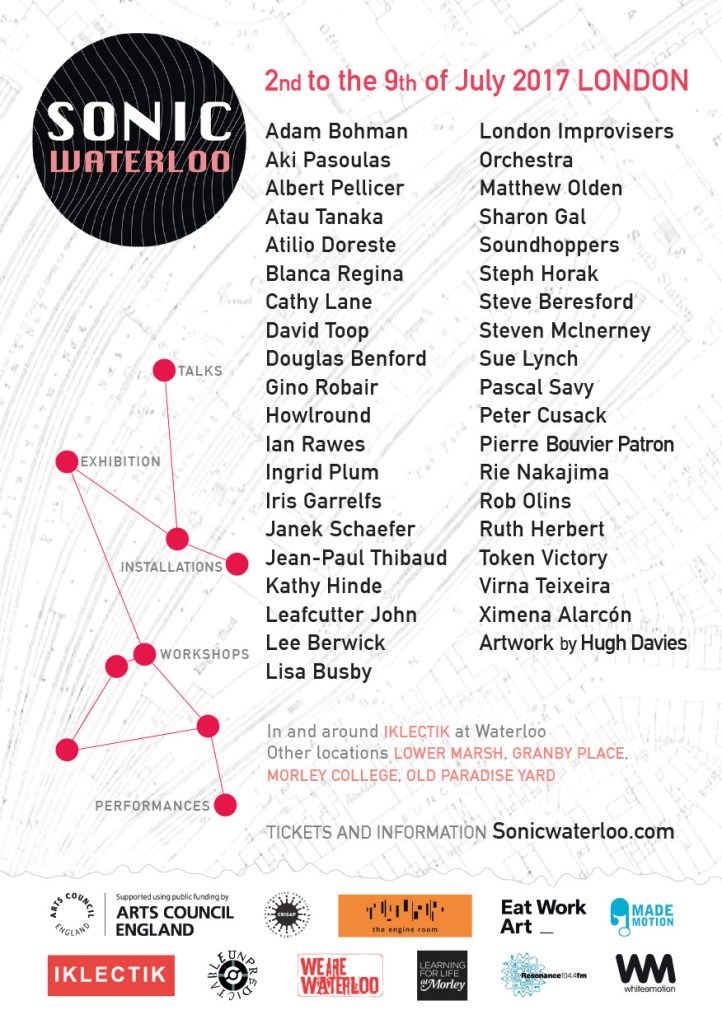
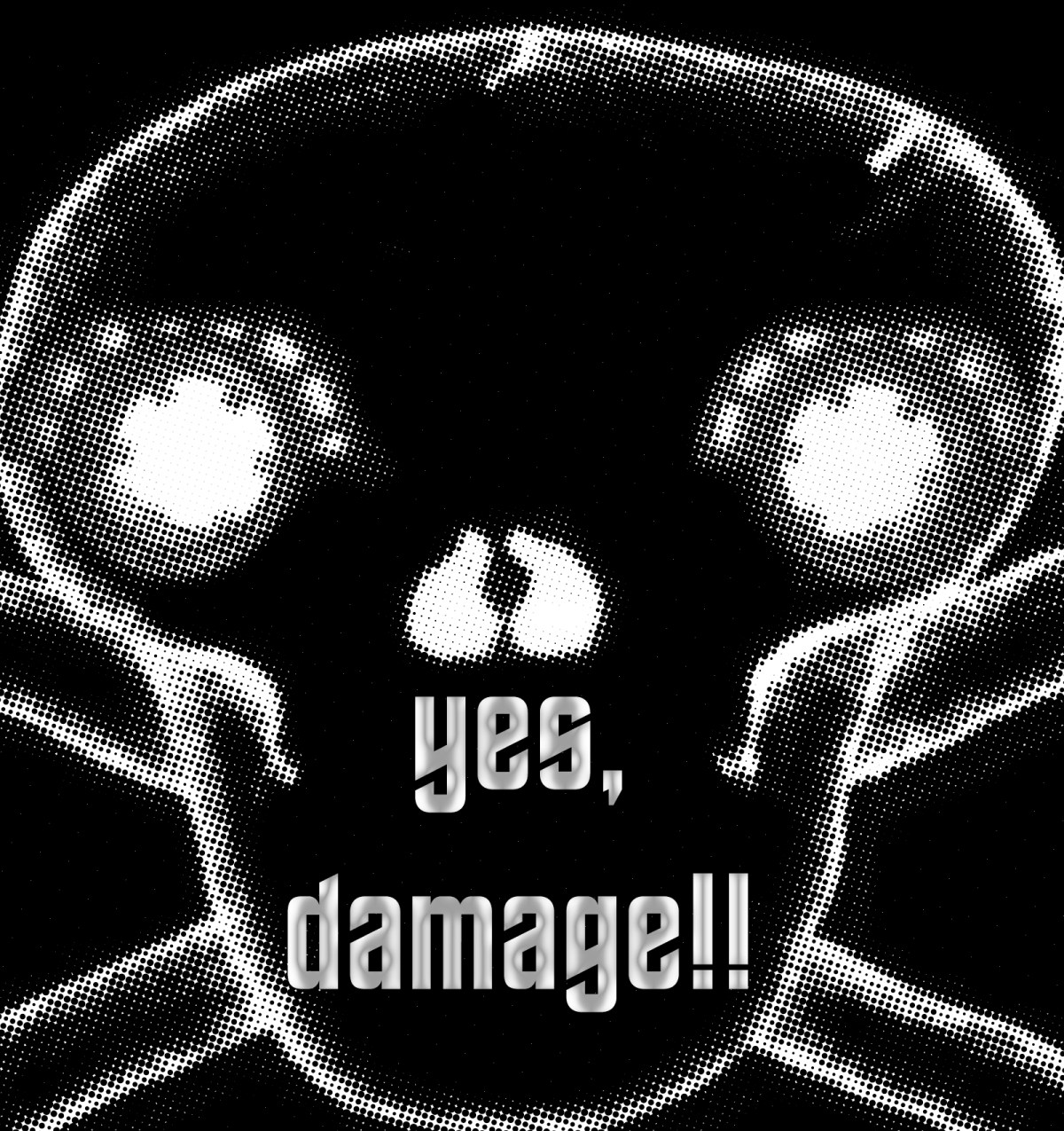
In what is shaping up to be a busy summer, we’re also playing Sonic Waterloo on July 8th and Supersonic Festival on August 5th, but more on those later. For the moment, I’m also very proud to officially announce the launch of another collaboration with White Noise, following last year’s East Tower Dreaming, a performance and suite of compositions broadcast live from a West London tower block facing imminent demolition. Tower blocks play another, rather different role in this latest work, ‘Yes, Damage!!’, a mixtape of sorts featuring a number of new compositions created using a cassette recording of a pirate radio station from my mis-spent youth. The source material is a nondescript-looking, rather battered TDK D90 cassette featuring a recording of a station known as Pressure FM. Originally taped in the 90s by a family friend and sent up north to me, it quickly became something of a sacred text and now has a permanent place in the Foggy archives as a testament to a bygone era and also to the very beginnings of my own musical obsessions. It’s surprisingly hard to remember today that there really was an age before the internet, when vast swathes of information weren’t immediately available at all times and where any small-town engagement with thrilling new sounds emerging from from far away would be limited to the odd mixtape, a handful of 12″ singles bought with saved up pocket money and perhaps the odd dog-eared back-issue of DJ magazine (or a new issue read standing in WH Smith while being tutted at).
I’ve produced this work as an attempt to pay homage to the role played by this tape in my formative years and to shaping my ideas about music and sound in general. I’ve said it before – and I cannot overstate it – everything I loved about hardcore and jungle back then I love about concréte and acousmatic music now, in fact as I’ve always attempted to demonstrate there is a very clear lineage between the two. ‘Yes, Damage!!’ is an attempt not only to pay tribute to the unwitting part played by the likes of DJ Damage and his unnamed MC in my career as a sound artist, but also take that fact to its obvious conclusion and create something new – hopefully pushing the sounds on into the future. Have I succeeded? Well, the proof is in the Pirate Pudding, so it’s probably easier to just play it and decide for yourself, but if you would like to read more on the work’s gestation, there’s an accompanying article on the White Noise website where I’m in conversation with Sound Fjord’s Helen Frosi.
Produced working quickly to a deadline, I was a little unsure about how people would react to the piece at first, but I have to say the response so far has been amazing! And it’s strange how well the original tape lends itself to being processed and manipulated in this way. As I mention in my conversation with Helen, it’s curious how this era of early hardcore and jungle music seems to lend itself to slightly decayed and debilitated sound quality. Cutting edge when first released, tracks featured on the tape by the likes of Rufige Kru and Noise Factory now sound oddly primitive, as if they’d been deliberately designed in anticipation of to reaching this state of putrefaction further down the line. Much in the same way as you’re apparently supposed to give concrete several decades to ‘mature’ when using it as a building material (thanks for that nugget, Brutalist walking tour of Liverpool!), so it seems as if these records have mulched quite naturally with the sounds of tape hiss, over-compressed signal and faltering reception to blossom into something wholly other and ripe for the plucking. Of course this also means that you don’t get quite the same effect when playing the individual records at home, amazing as many of them are and much as I still love them. Something about them being mixed together on the fly then beamed out to a grateful city via a jury-rigged rooftop antenna is where the magic happens. What’s also curious is that this recording dates from some time in 1995 and there’s at least one incident on the tape where the MC refers to Damage’s selections (most of which date from 1992) as ‘Old Skool’. They were calling it oldskool even then, three years later! What a time of tumultuous change within electronic music – to my (admittedly biased) ears this was the last era of truly dramatic advances, where it felt like styles and sounds were evolving on an almost weekly basis. Surely logic dictates we should be calling it ‘Ancient Skool’ by now? Just a thought.












:format(jpeg):mode_rgb():quality(90)/discogs-images/R-1433138-1308197430.jpeg.jpg)


 Robin The Fog