A few random bits and pieces to bring to your attention this week. Firstly, do you remember thatremixI produced for shouty London groove-merchants Chips For The Poor back in 2012? Well, I enjoyed doing it so much that it’s only taken me two years to produce another (with apologies to Gum Takes Tooth, who have been waiting almost a year for theirs – I swear I’m working on it!). This latest reworking is for the new Brood Ma Remix album on the awesome Quantum Natives label, that shadowy collective of beat-makers, programmers and graphic designers that includes Ornine, Yearning Kru and Brood Ma himself amongst others. If the name sounds familiar, it could be because his second album P O P U L O U S was the subject of a very flattering review in last month’s Wire magazine. To my ears it sounds like OneOhTrix PointNever or Autechre trying to make an oldskool hardcore record (with hammers), and indeed Daniel Lopatin has confessed himself a fan. Wasting no time at all, remix album re P O P U L O U S is out this week, and I’m very pleased to have asked to add a contribution. Two remixes in as many years? Nothing can stop this runaway train!
“r e P O P U L O U S” is a view of the original work from 7 different perspectives, as seen through a virtual reality headset slowly fossilising under ash and magma. Two of the album’s tracks, ESTEEM and NRG JYNX, have been rehewn and augmented, different stresses placed on the nervous euphoria and heat-hammered visions of the originals: Ornine’s chittering percussive trance ritual, Al Tariq’s industrial dancehall schematics, Recsund’s melodic electro strata, Yearning Kru’s cthonic collapse, Lyd’s open-air psychedelic zone, Robin the Fog’s claustrophobic pleasure release, and Ana Caprix’s distant, mourning viewpoint. These excavated snapshots reveal a wider panorama of a world moments before the inevitable”
You can check out re P O P U L O U S on the above soundcloud link or download the entire album here for FREE! There’s plenty more to be had, including the original P O P U L O U S long-player at the delightfully panoramic Quantum Natives website, while Brood Ma’s debut full-length F I S S I O N for Mantile Records is also well worth hunting down. I’m a bit of fan, can you tell?
Next up is Sarah Tanat Jones, a musician and illustrator that Chris and I met when Howlround took over the Alien Jams show on NTS Radio back in May (or rather we were invited by host Chloe Friedman and politely made ourselves at home, but ‘took over’ sounds more edgy and exciting). Sarah produces electronic synth-pop under the nameSynaesthete, equally groovy illustration under her own name (the above ‘Record Shops of Soho’ is, entirely predictably, my favourite) and co-runs the Kit Records label. Her music is very much in the vein of artists such as Glasser, and I’d even go so far as to say that her recent EP Earth and Air contained more glacial electro pop brilliance in its four tracks than on much of the former’s recent album. This is my personal favourite:
Now Sarah is asking for help to record her debut LP, Array, a CD and picture-book project combining her two talents. Releasing albums being the expensive business that it is, there’s a Kickstarter campaign that could do with your support here, with lots of nice benefits up for grabs. including original artwork. At the time of writing the totaliser is nudging just over the halfway mark with less than three weeks to go, so get cracking. You can also buy the Earth and Air EP here.
Lastly, and on a note that couldn’t be more different if it tried, I was sorry to hear this week of the death of Francis Matthews, the actor who, as part of a long and distinguished career, played detective Paul Temple; but was probably better known – somewhat to his chagrin- as the voice of ‘that bloody puppet’ Captain Scarlet. The archetypal dashing and debonair Englishman, I was lucky enough to interview him along with Alex Fitch for Resonance FM’s ‘I’m Ready For My Close-Up’ way back in 2009; and as there doesn’t seem to have been much else in the media by way of a tribute, Alex has dug up the original podcast. Hope you enjoy spending some time in his company as much as we did!
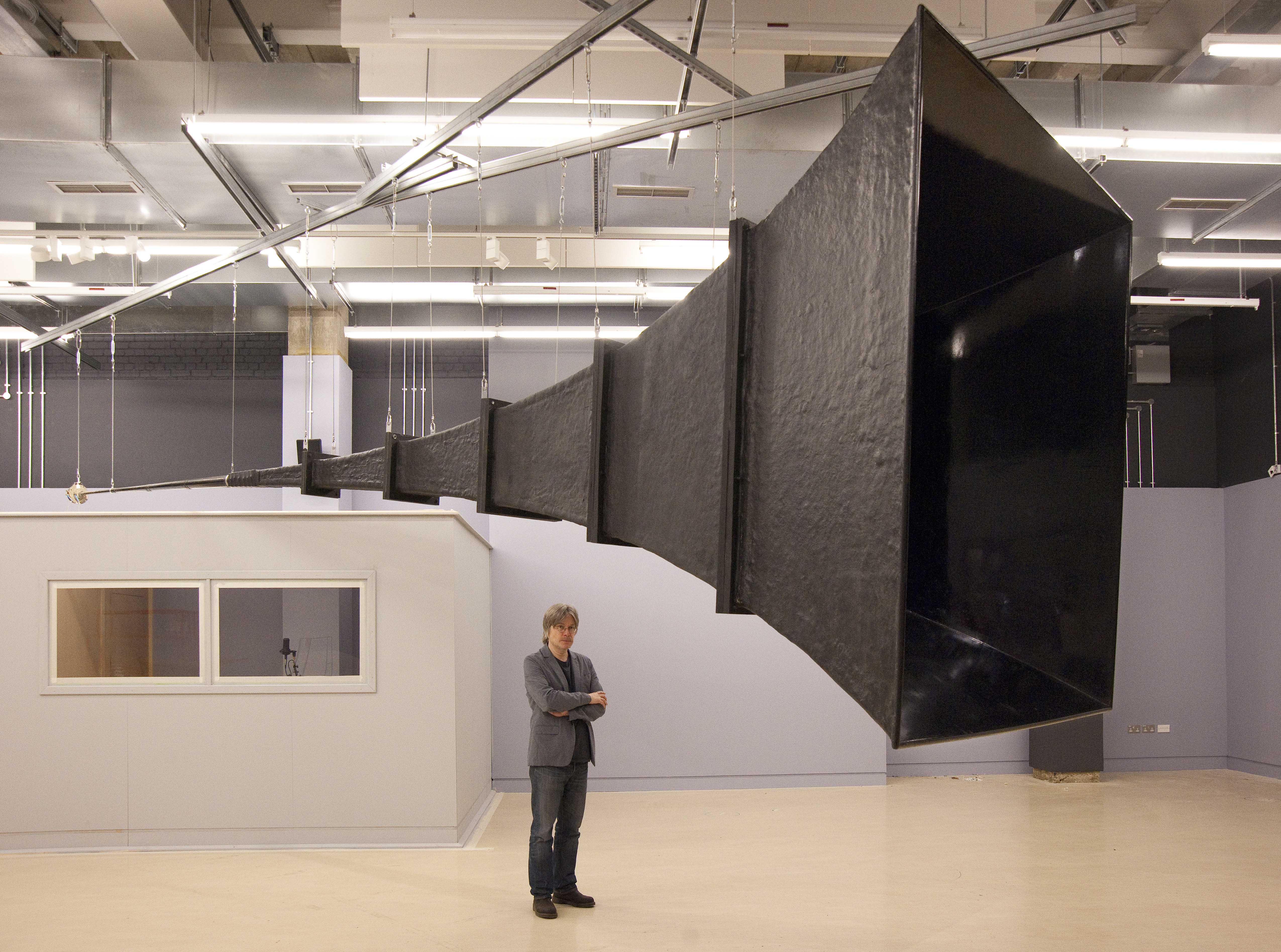
Aleksander Kolkowski and the Denman exponential horn, with the Resonance FM studio in the background
Presented for your approval, here is last Sunday’s OST Show Denman Horn Special, recorded live at the Science Museum and broadcast, depending on your geographical location, either down a colossal 27-foot exponential horn or on Resonance 104.4FM. Regular host Jonny Trunk was off down the seaside, doubtless trying to bag himself a coconut, or treat the family to some retro donkey-riding action; so once again I was charged with the task of steering Resonance FM’s soundtrack / library music programme through the choppy arts radio waters.
I’ve presented the OST show on numerous occasions, but never before had a 27-foot horn to play with, so I was determined that this special edition of the programme should have a bespoke playlist specifically designed to best honour Roderick Denman’s enduring legacy; not forgetting the efforts of Aleks Kolkowski and his team in bringing it back to life. The resulting hour is perhaps a little more ambient and drifty in nature than the usual groovy titillation, but features some quite marvellous new releases from Public Information and Arc Light Editions; as well as some classic radiophonic obscurities. Best appreciated on headphones if you don’t have a great big horn of your very own. As it were.
Or you can download it if you’re in a hurry. Here’s that horny tracklisting in full:
Selections from Tod Dockstader – Recorded Music For Film, Radio & Television: Electronic Vol.2 (Boosey and Hawkes, 1981 – reissue Mordant Music, 2013):
– Silver Float
– Stardrift In Two
– Snowbell Waltz
David Vorhaus – Sea Of Tranquility (A/B) ((The Vorhaus Sound Experiments, KPM, 1980)
Bill Fontana – Landscape Sculpture With Fog Horns, Live Radio Version, 1982 (KQED-FM, 1982)
As a bonus treat and an attempt to recreate a little of the magic of standing in front of the horn during the programme, here’s a recording of the above BBC Sound Effects montage made using a simple hand-held hard-disk recorder and sitting in the front row, approximately seven feet from that cavernous black mouth. This was made by sneaking out of the studio and grabbing a front-row seat, thereby simultaneously becoming both host and audience. Nothing can truly recapture the magic of hearing this recording while standing in front of a 27 foot horn, but until I can afford a big enough studio to build one of my own, it’s not a bad start:
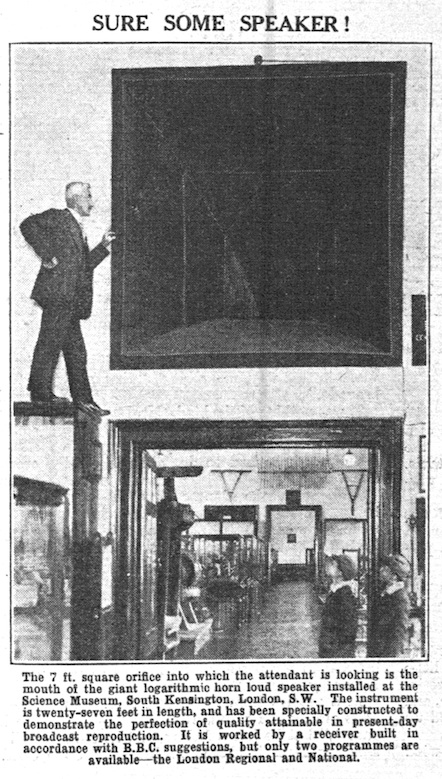
The horn in it’s orginial position, image stolen from the Science Museum’s blog.
Resonance continues to broadcast on-site until the end of the month, while the Exponential Horn exhibition ‘In Search Of Perfect Sound‘ continues until the end of July. I urge you to visit if you haven’t already, as nothing can truly replicate the experience of standing in front of the horn. No microphone will do it justice, it’s a full aural immersion, go and hear it while you can!
As today marks the release of two classic Radiophonic Workshop LPs that have received the heavyweight vinyl treatment thanks to deluxe reissue label Music On Vinyl, it seems only right and proper that I should finish off publishing the transcripts of my interviews with the various luminaries of the reformed and touring quintet of original workshop members, recorded at the University of Chichester for my BBC World Service report back in April. Our final subject is Mark Ayres, who joined the workshop late in it’s career and worked as a composer for Doctor Who during the ‘controversial’ Sylvester McCoy era. But it’s the extensive and exacting archiving, documenting and remastering of the Workshop’s historical recordings for which he is best known, particularly important within a broadcasting corporation that hasn’t always taken the greatest care of preserving it’s own legacy. Mark is also the brains and the galvanising force behind the workshop’s latest incarnation, which is touring the festival circuit this summer. Down-playing his contribution as ‘the archivist and general hanger-on’, he nonetheless remains the person most responsible for preserving the Workshop’s past and ensuring it’s future – a composer, an expert and a fan rolled into one. I started by asking him what he thought the Workshop’s greatest legacy was?
MA: It’s very difficult for me to say what the legacy of the Radiophonic Workshop is, I think that’s more for other people to express and [have an] opinion on. I know from my experience it’s something that I grew up with its very much part of my consciousness. I can see its influence in the world around me musically, aesthetically, artistically, in television and film, and I know what it has done to influence me. I wouldn’t be sitting here if it wasn’t for the Radiophonic Workshop. I went into music and sound largely because of being influence by the Workshop when I was a kid in the sixties. I was at primary school and we had programmes like ‘Music and Movement’ which was a kid’s programme where [they] were encouraged to do mimes and acting and movement and dance and whatever and all the sound was Radiophonic. So we were exposed to it every day at school and then we went home and watched Blue Peter and there it was on there with ‘Bleep and Booster’. And weekends we would watch Doctor Who. So it’s very much part of our consciousness, really. It’s what we grew up with, it’s part of the DNA of many people of my generation and I think part of the DNA of British culture.
RTF: How does the Radiophonic Workshop assert itself in the modern age, where electronic music has now become such a part of everyday culture and can be easily made on someone’s smartphone, for instance?
I don’t think the Radiophonic Workshop really needs to assert itself these days, the workshop is and the history and the back-catalogue is there. People can listen it, people can hear it, and people can be influenced by it. The fact that we are doing concerts now and people are coming along proves that people are interested in it and in seeing what the surviving members can still do. What I was very keen on was ….these guys are my friends and my mentors for many years I was very keen to give them a platform. To show that they’re still creative and that they’ve still got something to say. And I certainly think they have and certainly the audiences that are coming to see us now, the response is amazing.
How would you describe Radiophonics to the uninitiated?
Well, the Radiophonic Workshop came about when in the 1950s BBC Radio 3 in particular was starting to do a lot of very experimental drama and couldn’t find the appropriate sound and music in the library or in the sound effects archives to illustrate this. And a lot of producers became very aware, with what was happening on the continent in French and German radio in particular. Where they set up electronic music studios to explore [for example] in Paris, musique concrete – that‘s found sound. Here, I’ve got a drinks glass [picks it up, taps on it] I’m just flicking that with my finger, and that makes a sound. If I record that and vary the pitch of the tape I can make it ‘sing’. So that was what musique concrete was. Not just wine glasses, any found object, even the table or my glasses; anything can make a sound and you can make music out of that sound. In Cologne they were more interested in computers and in what sounds came out of electronic circuits. This was being watched at the BBC and they thought ‘we can use these techniques to illustrate our dramas’. So, they weren’t making ‘art music’ the way they were doing on the continent, they wanted it as a very practical contribution to making high-brow drama. But of course they didn’t put any money into it, so we had two people in particular Desmond Briscoe and Daphne Oram who started doing this work after hours when everyone else had gone home, they’d go down to the studios, nick all the gear, wheel it down the corridors put it all together, do the work and then try and put all the studios back together for the next morning. And eventually after that it was realised that they had to set up a department to do it.
So, what is Radiophonics? Well, Radiophonics is new sound, unknown sound. In its purest form it is using sound to illustrate the unknowable, I suppose. In the early days it was all plays about people having nervous breakdowns or someone sitting in his bath or something like ‘The Dreams’ which was one of four inventions o radio created by Barry Bermange. He did vox-pops, interviewing people about their dreams and later on about their views of God or the afterlife and he cut these comments together in a sort-of poetic fashion, rhythmic fashion, using a lot of repetition and making sure that the voices had a rhythm to them. He would make a script of what he’d recorded, cut these together and then give it to Delia Derbyshire who would then create background [music] to illustrate these.
And again [the question] was ‘how do you illustrate a dream state in a way that is purely subjective?’ You could cover it with Sibelius and Debussy if you want, it will probably work very well’ but it will immediately have its own associations. We don’t want to do that, we want the audience to make their own associations. So you have to give them something fairly neutral. And that’s where the Radiophonic Workshop [comes in], and of course in doing so it creates its own beauty, its own ethos, its own place in the world. And particularly The Dreams [became] this out of body experience if you listen to it, close your eyes and just let it wash over you, it is very dream-like in its own way. It’s a dream-like programme about people’s dreams.So that was a very early sort-of ‘pure’ radiophonic programme. And of course later on it became obvious that, say, if you were making ‘Quatermass and the Pit’, electronic sound was a very nice way without having to use the same kinds of sounds as everybody has heard before to illustrate the ‘Id Monster’ coming alive […] or the Martian consciousness re-awakening in the pit. So that was where it really excelled. Later on the Workshop became much more of a music factory, as television particularly just wanted more cheap theme tunes. As radio budgets decreased there was no longer the budget to allow the Workshop six weeks to experiment and see if they could come up with something. Which is what the BBC was about in the 1960s, [but] it certainly by the 80’s was not about that at all – it as about ‘we have a budget, you will make a programme, can we have it by Tuesday week’. So it became much more of a music factory. That eventually led to its demise, because it couldn’t compete with freelancers from outside who by that time had very similar equipment and could do a very similar job. Again, what we’re trying to do now is to allow ourselves to be purely experimental. A lot of our music is still very visual, we’re still using a lot of video, it’s still applied music and it is still music which is trying to evoke a mood or tell a story. But we’re now allowed, as in the 1960s, we’ve got the time to produce what we want and to experiment in the way we want and to combine all the techniques that were developed over the last fifty years to do something hopefully new.
This is the new album you’re referring to?
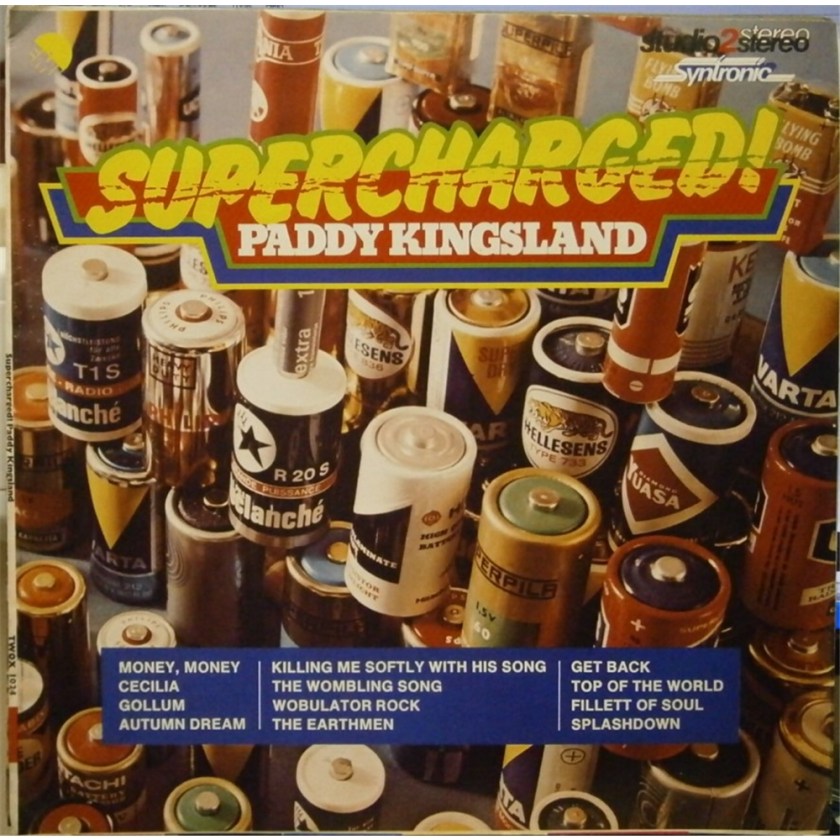
Well, this is the new album and what we’re doing on stage now. It’s taking all these techniques and learning from them and combining them and building on them. I can’t tell you that much about the new album because we’re still very much in the stage of throwing things up in the air and seeing what happens. We do have a working title which is Electricity and we’ve all been writing tracks which explore the theme of electricity. So Peter’s got a track which is called ‘Electricity’ which maybe the title track, I’ve got a track called ‘Galvani’, we’ve got one called ‘Wireless’ which Paddy Kingsland has written; another Peter Howell track ‘Til the lights go out’. So it’s all explorations on the theme of electricity and what it means to us in our lives. It’s almost like a ‘Horizon’ programme in the way we’ve approached it, in terms of finding a subject to illustrate; but we have the total free time to go and explore that theme individually and then all bring ideas back to the group and put it together. That’s what’s fascinating about this whole process. We’ve all been individual composes working in our own studios and now we do that as a starting point, but then we take it to the band and we see what everybody else can contribute to it. And there’s an ideology, a definite theme and content to what we’re doing.
The way electronic music is made now, you could literally press play and a computer could make a nice pretty tune for you, but I think sometimes modern electronic music loses that sense of having to say something, of having an idea to communicate.
Electronic music, certainly from the 1980s onwards – and this is part of what killed the workshop, it suffered from ‘pre-set-itis’. Because digital synthesisers came out which all came with fantastic pre-sets and pop music did those pre-sets to death! Also, when you were doing television music and you had literally 24 hours to put a theme tune together, it was very easy to use a pre-set. And it’s no good saying to the client ‘I want to do something really original, it’ll take me a week’, they’ll say ‘well, somebody else can do it by the morning’. [You could argue that that somebody else is] just going to use all the pre-sets, [but] nobody cares. So there was a slightly let-go attitude for a while. I know people who will buy a new synth and completely wipe memories before they even listen to the pre-sets. I won’t go that far, but I do make, as much as possible, all my own sounds. Because to me that’s what the fun of electronic music is about.
The aspect of digging to find the new sounds inside the machine, I suppose?
If I want to write for a combo, I can write for a rock band or I can write for an orchestra. The whole fascinating thing about electronic music for me is creating the orchestra and then writing for it! So everything should be new, it’s new combinations of sound, new combinations of techniques. Trying to surprise yourself, really. Exploring the happy accidents and allowing yourself the freedom to make mistakes and learn from them and have accidents which actually will lead you down a new pathway. You have to take the mistakes seriously.
Could you tell us a little about taking classics Radiophonic works and transferring them into the live arena? How did you go about it?
Doing this live is interesting because again by its nature, we’d slave away in the studio for many long hours putting piece of music together and by its very nature it is not performable live and yet here we are performing it live! So there is an element of ‘we prepared this earlier’, but also in every track we’re trying to find something which we can do live, that we can do differently that will surprise the audiences, which makes it interesting for us. We’re doing ‘Greenwich Chorus’, for instance, which is one of Peters’ famous pieces. There’s a couple of surprising elements in that which we’re doing live which makes it different, because it’s got to be different, it is presented live. And something like Dr Who, again, just to go on, it took Delia Derbyshire six weeks to do the original theme, it took Peter Howell six weeks to do his revised theme in 1980. We can’t expect the audience to sit there for three months while we do that, so we’ve got to find a short-cut. So we’ve found a way of de-constructing it, pulling to bits, building it back up again and then doing something entirely new with it, which we can present live. So that’s the fun for us [when] doing the concerts – finding ways of tearing this stuff apart and rebuilding it so that it retains its essence but is also a live experience as well.
Many thanks to Mark for being such informative and entertaining company, and the equally-stimulating interviews with his ‘friends and mentors’ Dick Mills, Roger Limb and Paddy Kingsland are all still available for your perusal; as is the original report which can be found here. The 180g vinyl reissues of Peter Howell’s Through A Glass Darkly and Paddy Kingsland’s The Fourth Dimension are both out today and available from musiconvinyl.com. The reformed Radiophonic Workshop band are touring the festival circuit throughout the summer. And they rock. Trust me on this.
A rather hurried post today, starting with an extract from Howlround‘s final gig (for the time being) at The Electric Dog Show, Power Lunches from earlier this month. It’s a ‘greatest loops’ set of sorts, so you may hear a few of our favourites alongside some brand new material, of which we now have rather a lot. We really do need to start knocking it all together into that album we’re supposed to be getting on with:
You can read a very complimentary review of the entire event (including superb sets by Quimper and Gyratory System) by Michael Holland (who we also have to thanks for these lovely photos) on the Ears4Eyes blog, but I’ve taken the liberty of quoting the paragraph pertaining to ourselves here:
‘Howlround were amazing, perfectly eerie, a droning, revolving yawn of sound, a morass of crumbling noise, whale moans, the distress of slowly compressing hulls and skulls, they conjured a hard to place melancholy – perhaps from the knowledge that the tapes and machines are at the end of their lives, still vibrant but with numbered days. Long strands of tape spun around stands, the duo stumbled around the flickering web like spiders, the audiences’ minds caught and bound, constricted further with each passing minute. A ballet of thread-hanging twirls, or a pair of tape-architects measuring drone boundaries for fencing-in sound-ghosts…
In other news, a most flattering post regarding Howlround’s debut album The Ghosts Of Bush (as well as a few other bits and pieces from the Foggy Archive) appeared this week on the excellent A Year In The Country website. Filed under ‘Trails and Influences / Other Pathways’, it’s the latestof the blog’s extensive investigations into ‘the underlying unsettledness to the English bucolic countryside dream’, and proves as immersive and well-researched as ever. This is amply proved by the fact that they dug out this home-made press release I’d forgotten ever making: And lastly, to pile glory upon glory, ace music curators and Boomkat offshoot 14 Tracks have included ‘неизвежбан‘ from Howlround’s second album Secret Songs Of Savamala in their recent selection ‘Psychoacoustic Geography‘. It’s the second time I’ve been featured on one of their regular download compilations, each one centred around a specific theme; and this latest selection also features work by Ingram Marshall, Moondog, David Toop, Janek Schaefer and Anne Guthrie amongst many more! Very proud to be in such company, particularly as the reissue of ‘Fog Tropes’ on Arc Light Editions is, entirely predictably, my favourite reissue of the year to date and one of my favourite releases full stop. And so, as Howlround prepares to head back underground to concentrate on finishing albums and shunning the spotlight (and as Chris prepares to head to Dubai – thus making the project a truly global concern), we appear to be experiencing one last flurry of welcome publicity. Hopefully this will keep our enormous fan-base happy long enough for us to get our act together and finish the three album’s worth of material we currently owe various people. Best foot forward, then.
Continuing with the publication of extended interviews gathered for my recent BBC World Service report on the revival of the Radiophonic Workshop, we come to a figure who perhaps more than anyone else embodies the spirit and the ethos of this most enigmatic of organisations. But where on earth (or, more appropriately ‘off’ it) to even begin with Dick Mills? The only surviving member of the Workshop’s original line-up and its longest resident, he joined in its inaugural year of 1958 and remained for the next three and a half decades. Originally joining as a technical assistant, he may have few full-length compositions to his name, but his innumerable uncredited contributions and practical assistance to the works of others; plus the sheer number of sound effects he is responsible for are almost beyond estimation. Such technical and engineering expertise may well account for the matter-of-fact and rather self-effacing way he talks about his work, despite remaining a stalwart of the workshop for significantly longer than anyone else.
Chatting briefly with him before our interview, he revealed that the Workshop’s cancelling of a number of tour dates prior to the Chichester University symposium last month had been on the orders of his doctor; something he clearly still felt bad about. And yet his band-mate’s reticence to go on without him is entirely understandable. The Workshop simply wouldn’t have been the same without him, then as well as now. Thankfully in better health, our interview took place in the green room during a short interval before Mills was whisked off for another panel discussion; and while we were pressed for time this most genial and chatty individual still managed to lift the lid on his contribution to the most famous TV theme tune of all time and the genesis of a forty-year-old radiophonic classic entirely his own:
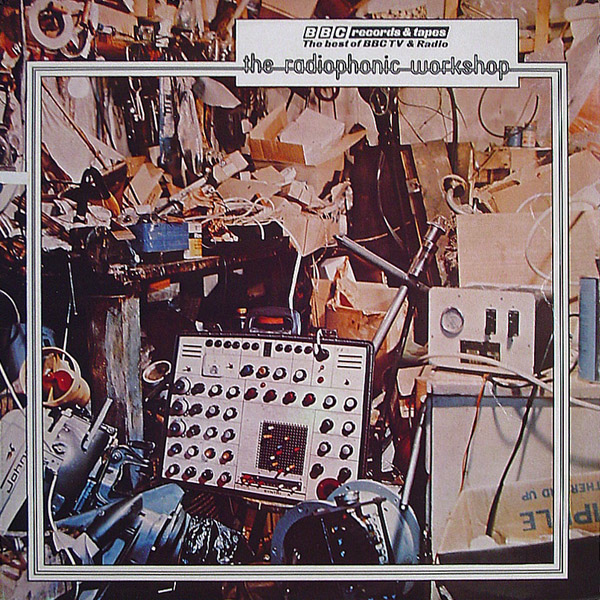
DM: [Examining the copy of the 1975 LP The Radiophonic Workshop I’ve just asked him to sign] Which one is this? […] Ah, yes. We come up against all sorts of people, you know. We went on [insert title of well-known ‘Blue Peter-for-adults’-style TV programme] to talk about the workshop. And [The Producer] says ‘Oh, it’s lovely to meet you, I was ever so interested in that record!’ [Indicates the photograph on the sleeve] ‘Is that the Radiophonic Workshop? I said no, that’s our boss’s shed, because he’s got an outboard motor there from his boat, [and] there’s a model yacht up there and an anchor there, that’s not the [workshop]! She really thought it was, she had no idea what we actually did there!
If I may say so, I think your track ‘Adagio’ from this album is one of my all-time favourite pieces of music.
My wife can’t stand in the same room as it. I took it home ‘cause I was so pleased with it. And she came out white as a sheet! She said ‘I actually hate it!’ She said ‘I would take that cassette out and cheerfully jump on it!’ I said ‘Why?!’ I think I’ve worked out that my wife, poor unfortunate; she hasn’t got the ability to suspend her belief. She would probably tolerate science fiction but she knows it could never happen. I said ‘well you’re approaching it from the wrong [angle]. Why can’t you… this could happen!’ And she says ‘But I know it couldn’t!’ It’s though her imagination can’t comprehend an open space or a space that she can’t see the limitations to.
What was your brief when you were creating Adagio?
There wasn’t any. This record, I don’t think contains anything [produced by commission]. [They] said ‘Oh, have a dabble and if we get enough we’ll put it together and put it out on a disc.’
That must have been quite unusual for the workshop?
Yeah. Actually, I tell a lie. Because this ‘Adagio’ I actually did compose for [pauses to remember]… well, no, I used it for a show that I was involved on called… What was it, Captain Zep or was it Duke Diamond? [NB It was Zep, although Mills worked on them both] Kids television about an academy for space cadets, a detective series. The students were shown a crime being committed and they had to deduce who did it. But because it took place in this big academy and the students are in an auditorium, before it started they wanted some ‘muzak’ to go over this auditorium [scene], so I did that. And they just played it over and over again in the auditorium and I got extra PRS because the students and the characters in the play could hear it and it was wonderful! Then I did a… I’m not sure if I did a similar piece… no, it’s not on here… called ‘Come and Go’* because what I did I did a bit of like Adagio and made a long length of it, turned it round the other way and joined it up [gestures handling tape] so it went like that and went away again! I just spent an afternoon meandering with a synthesiser and put some twinkles on it.
For me, personally, it’s one of the Workshop’s most haunting works.
Yes! It’s funny, a lot of record reviewers when they [wrote about] the workshop, the came out and said ‘the most surprising thing on this record is Dick Mills, we didn’t know he did music! Well I wouldn’t class that as music, that’s the trouble! It’s not written as music, it’s just… extemporised, I suppose.
You wouldn’t call it music, though?
Well, I would, you know, tonal-wise. Yes, rather than a sound effect. Or you could call it ”the music of the spheres” or whatever. You know, it’s just… [trails off, shrugs]
Your background was more in the creation of the sound effects, particularly for Doctor Who. And you also helped produce the iconic theme tune?
Oh, yeah! I did [the Doctor Who theme] with Delia and we stuck it all together. Actually, at last year’s fiftieth anniversary party at the Excel Centre, I did a presentation on how we put the signature tune together. I managed to get the components – three separate components – and I played them on the computer and I actually photographed the screen so that you could see the traces going along and then I put all the traces up and showed how they all went relative to each other. And then I described what happened when we [encountered] a bum note and couldn’t find it. We had to unwind all the tapes down the corridor and count the joins. That was the only way of [finding] it.
The Doctor Who theme is an enigma, if you like, to most people, because they can’t actually latch on to any known instrument that they think might have been used to make it because there wasn’t any musical instruments. It consists of three basic music lines, a bass track that goes all the way through then you‘ve got the melody that goes most of the way through, then the twiddle-y bits on the top and the whoosh noises that makes the graphics behind it. So Delia and I would have constructed those on thee separate tapes that had to be played together. No synthesisers, no multitrack, nothing. So the bass note was a twanged wire, which then had to be speeded up or slowed down to give you the right pitch, then then had to be cut together to the right length. Then everyone of those bass note phrases had a little grace note stuck ion the front which was an extra ‘whurrp’ from an oscillator. Then Delia did the melody ‘OOO-EE-OO’ with an oscillator she just waggled the knob until she got the phrasing correct; then she had to copy those how many times she wanted it and cut them all together. Then the white noise was whoosh-y noise, [we] played it backwards and looped it, speed-changed it, mixed it all together. Then we played the three tapes together… and there was a mistake!Now, nobody can watch three different reels of tape being played and spot where the mistake is, particularly as each of these tapes were full of splices. So what we had to do was to unroll these three rolls of tape, right down the corridor at Maida Vale, and walk along looking at the visual pattern of the splices. And when one of the splices was out of [the] visual pattern that’s got to be where the wrong note is.
As someone who makes music with tape, I do know how unpredictable it can be.
Yes! And you’ve only got to store it too long [for] the joints to dry out! But usually we didn’t have too much problem. Sometimes the backing on the tape was of a funny composition and sometimes the editing sticky[tape] was of a different make and it just wouldn’t stick on, but we didn’t have too much malfunctions, as they say. There was a trick that you’re supposed to wind a tape on inside out because if there [were] any loud passages in the tape it tended to print through magnetically to the next layer of tape on the spool. And if you wound it backwards or perhaps inside out, it would print after itself, so you wouldn’t get a pre-echo or a loud noise and so know what was coming! It was silly and nobody ever went through and tried to prove it!
And with that, he was ushered away to join the imminent panel discussion occurring in the main hall. What an absolute treat it was to spend some time with him. And as an added treat of my own, I’ve found some footage of the aforementioned children’s science fiction quiz show ‘Captain Zep’ on youtube and have included it below for your edification. Sadly, this slightly poor edit was the only clip of the programme I could find, but gratifyingly it does include the auditorium scene with an extract from ‘Adagio’ playing in the background, just as Dick described it. It’s interesting to note that, despite being quite a bit older, his music has aged far better in the ensuing decades than the ‘Captain Zep’ programme itself – It’s hard to believe that puffy yellow ‘space-clown’ uniforms, copious amounts of hair-gel and extended scenes pertaining to the distribution of badges to schoolchildren could ever be considered essential televisual ingredients, though respect is due to lead actor Paul Greenword for keeping straight-faced throughout:
For those of you hungry for more, a complete overview of Dick Mills’ credited and uncredited work would be far beyond my capabilities here, though any fans of classic Doctor Who will recognise much of his work – he was the principle ‘special sound’ creator for the series’ original run from 1972 onwards, the best part of two decades. The BBC Records Special I produced in 2012 for Jonny Trunk’s OST show is a good place to start, though I say so myself, featuring as it does a number of his original compositions, including several from the ‘Hi Tech FX’ LP, which should be considered an essential purchase for fans of the Doctor, sound effects and electronic music alike! And anyone who can offer me some information regarding the track ‘Come and Go’ that Dick mentions is encouraged to get in touch. I can’t find the slightest reference to it anywhere!
Finally, on a more whimsical note and as a bonus for you synth obsessives, here’s a rare chance to see the classic EMS Synthi that features on the ‘boss’s shed’ cover of The Radiophonic Workshop LP (and was one of the most important tools in the creation of sound effects for Doctor Who) in a far, far less illustrious setting – half-hidden in the background of a minisculely-budgeted CBBC atrocity from the 1980s that must count as one of the most genuinely disturbing pieces of television you’ll ever have to sit through. I’m quite sure I won’t be alone in stating that if I happened to be in possession of such classic hardware, I could think of 1000 better things to do than dangle nasty wobbling puppets all over it – typical BBC squandering of resources! That said, this clip remains my staple riposte to anyone who dares to tell me things aren’t as good as they used to be. And there’s bonus points if you survive long enough to catch a flash of Edd The Duck at the very end, no stranger himself to appalling pond-dwelling pop.
The sublime to the ridiculous writ large. I think I might need a bath now…
Thanks you for your email. It’s really good to hear that my work is reaching such a wide variety of places and I thank you for taking an interest. I have to confess, however, at being just a little confused as to your reasons for getting in touch.
If indeed you have visited my website (and let us assume that your writing to me regarding its content suggests that you have), you will have noticed that it’s primarily concerned with the subjects of Radiophonic broadcasting and experimental music, with particular emphasis on the activities of the tape-loop quartet Howlround (who, as I’m sure you’re aware, unveiled some brand new material EXCLUSIVELY onNTS Radio’sAlien Jams show last week and are playing their last gig for the forseeable future on May 7th at The Electric Dog Show, Power Lunches, Dalston). However, with the exception of occasional reference to the anti-social hours one is forced to keep while ploughing these particular furrows (including the long nocturnal sessions working on their highly-regarded 2012 LPThe Ghosts Of Bush), I think I’m correct in stating that my extensive online content has rarely if ever turned to the subject of purchasing beds. It has certainly never been my aim to send my readers to sleep, and while I have had my music branded ‘eerily soothing’ in the past; I’m not really sure it’s the kind of soundtrack a customer of an online Bed Store would find conducive to a restful night’s slumber.
I’ve had a look at the website of the company in question and was pleased to note that their products do indeed appear sturdy and reliable. In fact, it looks like a pretty classy operation all-round, which leads me to assume that they make considerably more money flogging Ottomans and Mid-sleepers than I make shifting my small back-catalogue of short-run, experimental tape-loop music. Therefore I can’t help thinking that any organisation expecting me to endorse their already very successful business on my own personal web-page while palming me off with a measly twenty quid is frankly one open-coil spring short of a Star-Ultimate Maestro Mattress. Sorry, but I just don’t get out of bed for that sort of money if you’ll forgive my labouring a point.
In short, while I thank you for your offer, Slap-Up Media are going to have to consider slapping up quite a bit more before I start going to bed with any large corporations. At least buy me dinner and some flowers first. A ‘slap-up dinner’, naturally…
Very best wishes,
Robin The Fog
PS You’ll notice I’m typing these words at four o’clock in the morning, which should give you a pretty good idea of just how qualified I am to be giving anyone advice on the subject of going to bed.
For those of you who somehow found last Sunday afternoon’s weather conducive to doing anything other than staying in and listening to the radio (and found themselves lacking a smartphone or internet-ready umbrella), I’m very pleased to inform you that the latest edition of the Alien Jams show on NTS Radio featuring SPECIAL GUESTS HOWLROUND!!! (my caps) is now online for your streaming pleasure. We took the opportunity to road-test some brand new material from our as-yet-completely-unfinished next release, and indeed a sizeable chunk of airtime was given over to brand new works fresh off the spools, plus at least one new piece that will probably never be heard or referenced ever again. It’s something of a departure from our previous LPs, but we think it fits into the Howlround niche quite nicely. Dig in, won’t you?:
There’s other news this month, both very good and slightly bad. The very good news is that we’re excited to be playing The Electric Dog show at Power Lunches in Dalston on May 7th. Brought to you by Soft Bodies Records, we’re playing alongside Quimper and Gyratory System and it looks set to be yet another killer line-up to be slotted into! Further details here and there’s also a Facebook Event Page as there so often is with these modern events. The slightly bad news is that this will be your last chance to catch Howlround live for the FORESEEABLE FUTURE!
But before your throw up your hands and commence wailing and gnashing, I must reassure you that this is by no means the end of the our tape loop adventures, though given that I’ve just been boasting about playing exclusive new material from a forthcoming release, you may already have picked up on that. Aside from avoiding very real damage being caused to our quartet of Revoxes every time they leave my studio (not to mention our spines!), we’ve decided that now is a good time to hunker down and concentrate on building a solid repertoire of tape music while they still just about work. That way, when each machine is assumed into Revox Heaven (and the day cannot be that far off), we’ll have lots and lots of material in reserve that we can release posthumously in a steady drip-feed, while raking in the cash. A bit like Tupac. Oh, and Chris is moving to Dubai. Did I mention that?
So, a bit of a change on the horizon. I must admit I shall greatly miss jamming with my indispensable partner-in-tape who has bought so much to the project over the past year; but work will continue thanks to the wonders of THE INTERNET and we’re both very excited about where things are going (quite literally, in Chris’s case). I hope that after a listen to the new material on the Alien Jams show you’ll be just a little excited too. Just a little…
Continuing with my interviews from the alumni of the BBC Radiophonic Workshop, we move on to genius composer Roger Limb. Part of what I suppose we could call the department’s ‘second wave’, he joined the workshop at the dawn of it’s synthesiser era in 1973 and worked as one of its principal producers and composers for over two decades, creating a huge body of signature tunes for television and radio drama that will almost certainly be familiar to anyone growing up in the UK over the past thirty years. Perhaps best known for his substantial contributions to Doctor Who during the eighties, he also recorded and produced many of the songs for the cult BBC Schools programme Look And Read, including the famous ‘Magic E’ song that became the subject of much rather tiresome postmodern chuckling in subsequent years:
A respected pop and jazz musician outside of the workshop, Limb has now rejoined his friends and former colleagues as part of a revamped Radiophonic Workshop band and will be touring the festival circuit with them over the summer. This interview took place during a rather brief interval in a long day of discussions and performances at Chichester University. Despite being pushed for time, however, Roger’s additional years as a voiceover artist and continuity announcer for the BBC meant that he had no trouble putting his points across quickly and succinctly!
RL: I think the Radiophonic Workshop has a sort of legacy, [because] even though it closed down 15 years ago, there’s a whole generation of people for whom the phrase ‘Radiophonic Workshop’ has some sort of mystical quality. When they were kids, perhaps they saw the name on the screen. Or they heard the back announcement on radio [and thought] “… Radiophonic Workshop – what does it mean, who are these radiophonic workmen, what do they do , where do these strange uncanny sounds and strange music come from, what is going on there?” So I think a lot of people remember that rather mysterious atmosphere, and [had] questions about it that were never properly answered, questions that are still hanging in the air today.
Can you tell us something about the equipment and techniques used by the workshop?
When the Radiophonic Workshop first began producing music there was a lot of very strange and rudimentary techniques [involved]. The whole idea of tape manipulation – you get a piece of sound on a tape and you can do strange things to it: play it slower, play it backwards, damage the tape slightly, put unearthly echo on it… And [so] a lot of the early radiophonic music that came from the workshop was tape that had been manipulated. Later on there was quite a big change in the early 1970s when synthesisers became more and more used and the old tape cutting techniques went out of fashion. So for the last thirty years the signature sound of the workshop has been the synthesiser. But that doesn’t mean to say it’s [become] limited because the whole world of synthesisers, the whole world of sequencing and sampling has meant an enormous change and development in the techniques available for people who were doing electronic, radiophonic music.
With that in mind, I’m wondering what your thoughts are on modern electronic music, about how your influence has permeated down to the current generation?
I think there’s no doubt at all that the radiophonic workshop cast a very long shadow. Techniques have changed drastically in the last ten, twenty years and now it’s possible for people at home with home studios, even on their cell-phones, to create and play radiophonic music through wonderful speaker arrays and things such as that. There’s a huge market and a huge output of Radiophonic electronic music now. I don’t know how on earth [to keep track of it], it’s like the old question of loads and loads of people talking but nobody listening! I listen to as much of it as I can and from time to time I hear something that’s quite arresting, something that obviously a person ha put a lot of thought and ingenuity into. And that’s really quite interesting, but the problem is there is so much to listen to that it’s quite often just a happy chance if you happen to hear something [significant]. But I keep listening!
As a member of twenty years standing, you must have seen quite a lot of change at the workshop?
When I arrived there were about five or six studios in which each individual member of the workshop would set up their own little studio according to the way they wanted things, whether it was tape machines, synthesisers, or mixing desks. As time went on the techniques became more and more advanced and we had a little more money to spend on for example multi-track tape machines. And then another big change happened in the 1980s and that was the arrival of sequencing programmes on computers. Quite rudimentary to start with but developing in such a way that it was a joy to use, particularly for incidental music for drama when you could measure the action that was given to you on the tape or the film and express it exactly onto a sequence on a computer and [then] write the music around it. It was a wonderful tool to use.
Talking to you and to Paddy Kingsland earlier, the impression that I get is that there is a lot of excitement in the current line-up about modern developments in music technology, rather than simply using the tried and tested methods you would have used in the workshop at the time.
I think there is, but [out of all of us] I’m probably the most of an old curmudgeon, because quite apart form doing these gigs with the RW -we’re performing live quite regularly- I go out and do a lot of live jazz gigs, playing piano or double bass, playing conventional music and trying to do it in an unconventional or original sort of way. So when I hear about these [modern] techniques they talk about, recording and finding good samples from the recordings they do with the people who want to come and work with us, I was a little bit wary at first , I thought ‘hmm, this doesn’t sound like much fun to me’. But I’ve had a couple of goes at it and I must say that it’s growing on me and I’m getting more and more involved in using the techniques that have been prescribed. And I think a lot of positive stuff is coming out of it.
And finally, can you tell us anything about the new album?
There is an album due out and it’s going to be out in a matter of months, perhaps. We’re putting some final touches to it next month, in May. It will be called ‘Electricity’, rather appropriately. And there will be a lot of new stuff on it, but perhaps we will revisit one or two old tracks as well.
Many thanks to Roger Limb, and you can catch the reformed Radiophonic Workshop on tour over the coming months with further details to follow. In the meantime my Radiophonic Workshop reunion package for BBC World Service and Paddy Kingsland interview are both still available on this website for your perusal. Dick Mills will be up next, but for now let’s give the last word to Roger Limb, and another collaboration with the great Derrick Griffiths that will not only be instantly familiar to many generations of former children (indeed I can recall my entire primary school class singing it), but is quite likely to stick in your head all day. Stick. Stick-ing. Build yourself a word!
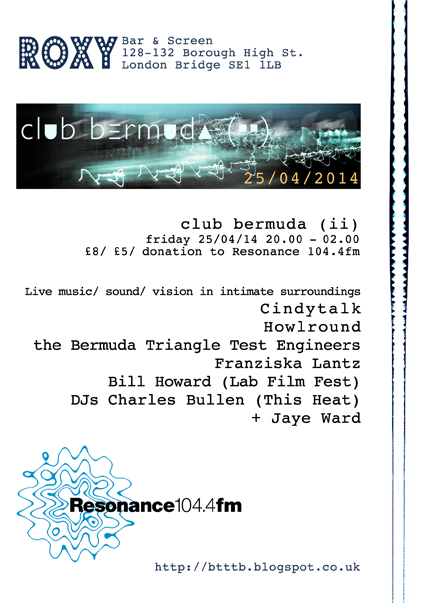
Very excited about this weekend, when Howlround will be spooling up for a live performance at the Roxy Bar and Screen as part of Club Bermuda ii. And a fantastic line-up too, including Cindytalk, Charles Bullen of This Heat and Franziska Lantz, who you might remember from our collaboration for Radio 3’s Late Junction a few months back. There’s also a Facebook Events Page for those of a social media disposition. All proceeds go to help keep Resonance FM on air and if the previous event is anything to go by, it promises to be a memorable evening for everyone concerned. Hope to see you there.
If that wasn’t enough, we’ll be guests of Alien Jams on NTS Radio at 5pm this Sunday, where we’ll be unveiling some brand new Howlround works exclusively on the show. These are fresh off the spools, less than a week old and will hopefully feature in some shape or form on a new release in the summer. It’s a bit of a departure from our currently released material, but I certainly hope you’ll find them sonically intriguing and am looking forward to giving them an airing!
Speaking of exclusive tracks, Howlround have contributed a previously unreleased short work ‘Wing to Wing’ to a CD sampler put together by Running On Air Music, one of the brains behind last weekend’s brilliant Archaeology event in Winchester. We had a fabulous time enjoying performances by Kemper Norton, Olan Mill, Stephen C. Stamper and Clive Henry and put on one of our finest turns yet, though I say so myself. Each of the aforementioned has also donated an exclusive work, thus making it pretty essential listening, quite frankly. Certainly the only way you’ll get to hear ‘Wing to Wing’ until our huge career retrospective is released fifty years from now. Available here as a very limited CD and download if you can’t wait until then.
As you can see, this 100th post is a rather busy and hurried affair, with lots to impart, which just goes to demonstrate what a busy couple of weeks it’s been. Remember that my BBC World Service feature on The Radiophonic Workshop Revivial and interview with Paddy Kingsland are both still available on this site for your viewing pleasure, with Dick Mills, Roger Limb and Mark Ayres to follow. But that’s probably enough to be getting on with for now. Hope to be seeing some of you over the weekend and I’ll leave you with this live mix I made for my good friends at NO-FM last year during my residency in Serbia, which has finally found it’s way onto Mixcloud. You should definitely check these guys out…
As promised, following last week’s report for BBC World Service, here is the first of four interviews with the veterans of the Radiophonic Workshop, the ‘Godfathers of British Electronic Music’, now reformed and touring their collection of vintage analogue equipment and classic radiophonic works to rapturous reception. They’ll be featured in the order I interviewed them two weeks ago at the University of Chichester, so we’re starting with synthesiser legend Paddy Kingsland; the man who definitely put the ‘funk’ into radiophonics. Best known for The Fourth Dimension LP (essentially a Kingsland solo album), he has a string of classic BBC themes to his name, as well as providing incidental music for such classics as Hitchhiker’s Guide to the Galaxy, Dr. Who and many more. Paddy has also recorded solo albums, made library music and jingles for KPM and worked alongside composers such as Michael Nyman. His signature sound is melodic synthesiser workouts with a strong rhythmic back-bone and the track ‘Vespucci’ is a highlight of their revived set-list. This interview, slightly truncated here, took place in the artist’s green room at Chichester University; with moderate interruptions from the air conditioning…
PK:I worked at the Radiophonic Workshop for the BBC between 1970 and 1981, which is quite a long time ago now. Of course I’ve done quite a lot of other things since then, but more recently I was approached by some other friends who worked at the BBC Radiophonic Workshop and was asked if I‘d be interested in doing some gigs with them – some live events. And so that’s what we’ve been doing. We started, actually, getting on for five years ago at The Roundhouse with a live show which went down very well. There were roughly two thousand people who went to that and they seemed to enjoy it. And we thought, ‘well, is that the two thousand people who might be interested in a show of that sort? Because if it is then that’s it, we’ve done it’! And so we didn’t do very much apart from make enquiries until quite recently, in fact a year ago, when we did a festival at Port Merion – Festival No. 6. It seemed to go down pretty well there, so we’re now doing a series of festivals this year.
We were asked to come [to Chichester University] because they have an event which is dedicated to the Radiophonic Workshop, which of course hasn’t been running for several years now. And so there’s all sorts of interest in that, so it’s a big honour to be asked to be involved. We’re doing a number of chats with the various people like Roger Limb, Mark Ayres, Peter Howell, also Dick Mills and myself. We’re doing some chats with people who are interested and asking questions of us and then after that we’re going to do our show which we do at festivals and so on. So I hope people enjoy that performance.
RTF: I’d heard a rumour there’s a new Radiophonic Workshop album?
Yes, there’s a new album we’re making as well alongside all of this, we’ve been working with one or two other people who are interested and quite eminent some of them, in electronic music and pop music. We’re trying to do some new stuff rather than just producing hits from the past. We’re not sure when it’s going to be finished, but we’re working quite hard on it. We have a marvellous addition to the group who is Kieron Pepper, a percussionist, a drummer and also a multi-instrumentalist – and a lot younger than we are with far more energy! He’s joining us on this and we’re preparing some tracks now and some of them we’ll be using in our performance later on tonight. We’re working with a few different people – I’m not going to say who yet, because we don’t know how it’s all going. But people from the electronic music world, the contemporary music [scene] and commercial music as well. And that’s really exciting, working with those people. So we hope to have some material to release later on in the year.
Will you be using some of the old radiophonic equipment?
We always have that on hand. One of the things about what we do is that we’re interested in trying to make our own sounds rather than having sounds that are already made for us. So quite a lot of the things we do are made by bashing things or by putting things through a treatment rather than just pushing a preset on a synth. Having said that a lot of the live stuff we do have to use presets from time to time – [though] we have actually made the sounds up ourselves in those cases, we try to make sure they’re sounds we’ve made ourselves.
It’s so much easier nowadays to make electronic music – using an app on a smartphone for instance. How does the Workshop define itself in this modern era when it’s much easier for everyone to dabble? How do you stand out?
It’s a good thing. I think the answer is that it’s always about the music. A lot of these methods of making stuff on a smart phone or an iPad – and I’ve got some lovely apps which you can play with and they’re absolutely beautiful. You can make lovely sounds on them. But I think if you look back at some of the great things that Delia for instance – and everyone’s got one or two things – [it is] quite distinctively them making a piece of music. It doesn’t really matter what they made it on, it was an expression of themselves musically. And I think that’s what we try to do. Maybe somebody will say ‘oh no, that’s not very good, the thing that that guy has just done in his bedroom is much better’. That’s fine, that’s the way things are with music generally anyway. But I think that’s the [correct] approach – to think about the music first and how you make it afterwards.
That’s one of the things I loved about the workshop, the emphasis wasn’t on how the music was made, it simply had to be made, it had a function to fulfil.
It’s all mixed up together isn’t it? It’s all part of it. If you just make a sound with the latest box, that’s fine. But really the luck in it for us was that we had, unlike a lot of other experimenters at the time, who were doing music to please themselves or to make an album at some later date; we had a deadline and work to do. It was a play or a documentary or something of that kind. Never a concert! But it was something which we had to fit in with. If you’re doing incidental music for a play it has to work for that play. The director’s not interested in your doing some outlandish thing that doesn’t [fit] the work, so we had a set of really good guidelines before we started. And that cuts everything down so you can actually relax a bit more and make something that’s suitable. And you can blame it on the project if it’s not something you like!
So you were working to a strict brief, it wasn’t a research body unlike the experimental electronic studio of the times. I had always thought that the members of the workshop would perhaps consider that limiting and yet what you’re saying is that you actually found that very liberating?
Well, it is because it makes it much easier for you. When you’re doing music to order, if somebody says ‘I’ve got this pay, it’s very, very sinister, uneasy atmosphere, something awful is just about to happen’; you can almost hear the music before you start. If somebody says ‘I’ve got this wonderful project, we’re asking five musicians to make any kind of music they like, you can do anything you want, you can hire an orchestra you can do it on a banjo, you can do it on synthesisers, electronics, lampshades, anything you like and we’re going to pay you for it’; what usually happens is you just kind of go into a daze and you find yourself unable to produce anything. Whereas if somebody says ‘I need this and I need it by Thursday, that’s something that allows you to work and it makes you work.
Do you have of your own work a particular favourite?
From the electronic era, I must say I do like some of the things from the Hitchhiker’s Guide to the Galaxy, some of the Dr Who shows I quite like now, and one or two of my theme tunes were quite fun: ‘Rugby Special’ and a few things like that, which I’m still quite fond of. But then when you listen to those things you remember where you were at the time and how it was and all of those things. Like listening to any piece of music, it brings back the memories surrounding where you were when you did it.
I remember doing a documentary called ‘In Tune When I Bought It’ and it was a documentary about guitars and guitar players, that sort of thing and it featured Hank Marvin and Pete Townsend and various people like that. And it was lovely to read a review where the reviewer – I think it was Gillian Reynolds – said ‘it brought back teatime on Saturday’. And it was lovely because that was the real intention behind making the show. It’s nice if you can put something in which is very difficult to describe and fairly abstract, but it comes across. That’s something that’s lovely about music, you can put things into music which say it better than words.
Any thoughts on what modern generation of artists have done with what you and the Radiophonic Workshop began, or at least bought to a much wider audience?
I hear things on the TV all the time, which is marvellous. Electronic music [that] I know John Baker and Delia and people would have really admired, because it’s so beautifully done and often very sparing and very underplayed and evokes feelings, particularly in some of the dramas now. And also the appreciation of just pure electronic sound is much more now by all sorts of people. Because I think generally people are less prejudiced now in all sorts of areas. They don’t restrict themselves in the way that I suppose we used to in our day, you know, ‘I don’t like that sort of music, I only like this’, or ‘I don’t like jazz or anything like that’ People are much more broad-minded now about al sorts of things, including music.
So you’ve been impressed by what the modern generation have been making?
Definitely, yes. The modern stuff definitely impresses me and it impresses me more since I’ve been working with people like Kieron Pepper, who’s our percussionist and a highly accomplished musician. And seeing how he approaches things and how it works – it’s just amazing how that generation are able to do it equally as well as we did. But they’re doing it at home, maybe with less facilities than we had by comparison.
Thanks to Paddy Kingsland for being such interesting and affable company and stay tuned for further interviews with Roger Limb, Dick Mills and Mark Ayres that I’ll be posting up over the next week or so. In the meantime, why not check out the ‘BBC Records Special‘ I made for Jonny Trunk’s OST Show back in 2012? Plenty of rare Radiophonic cues to be found amongst all the whistles and bells…





 In other news,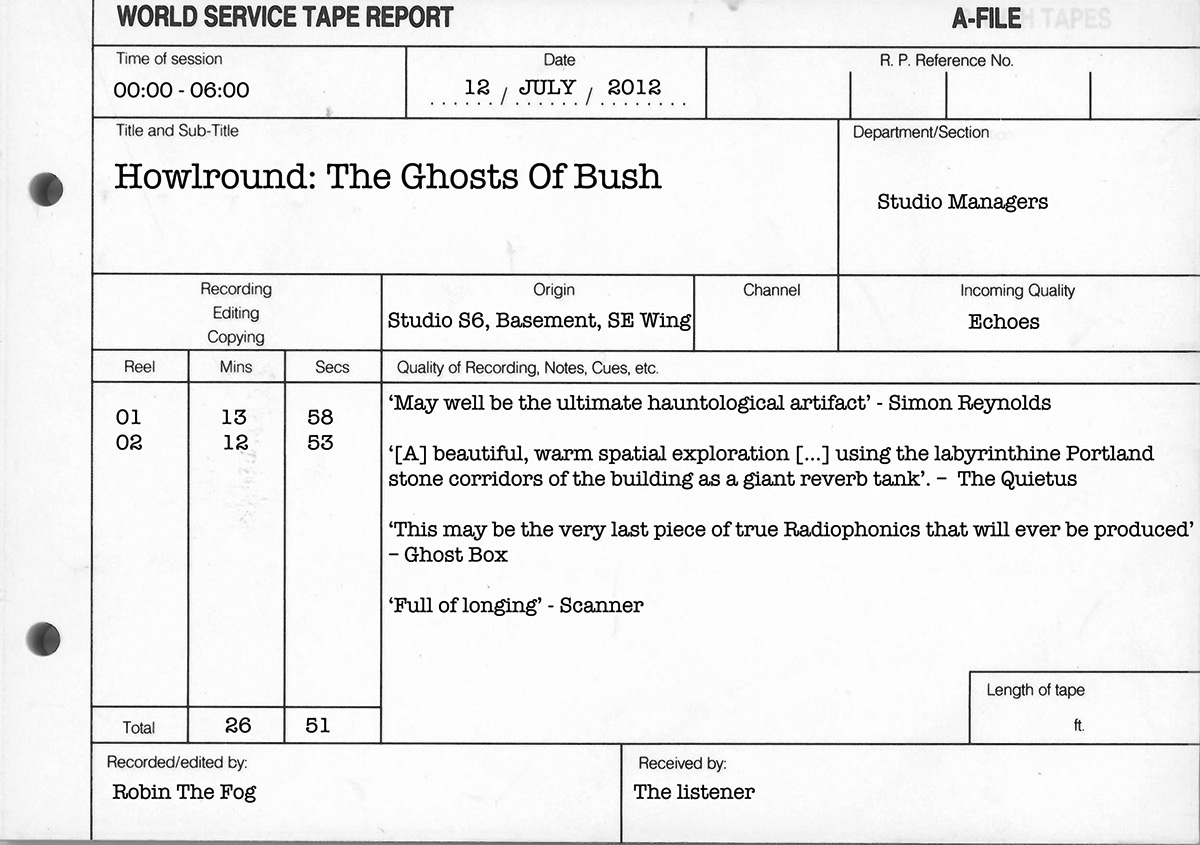





 Speaking of exclusive tracks, Howlround have contributed a previously unreleased short work ‘Wing to Wing’ to a CD sampler put together by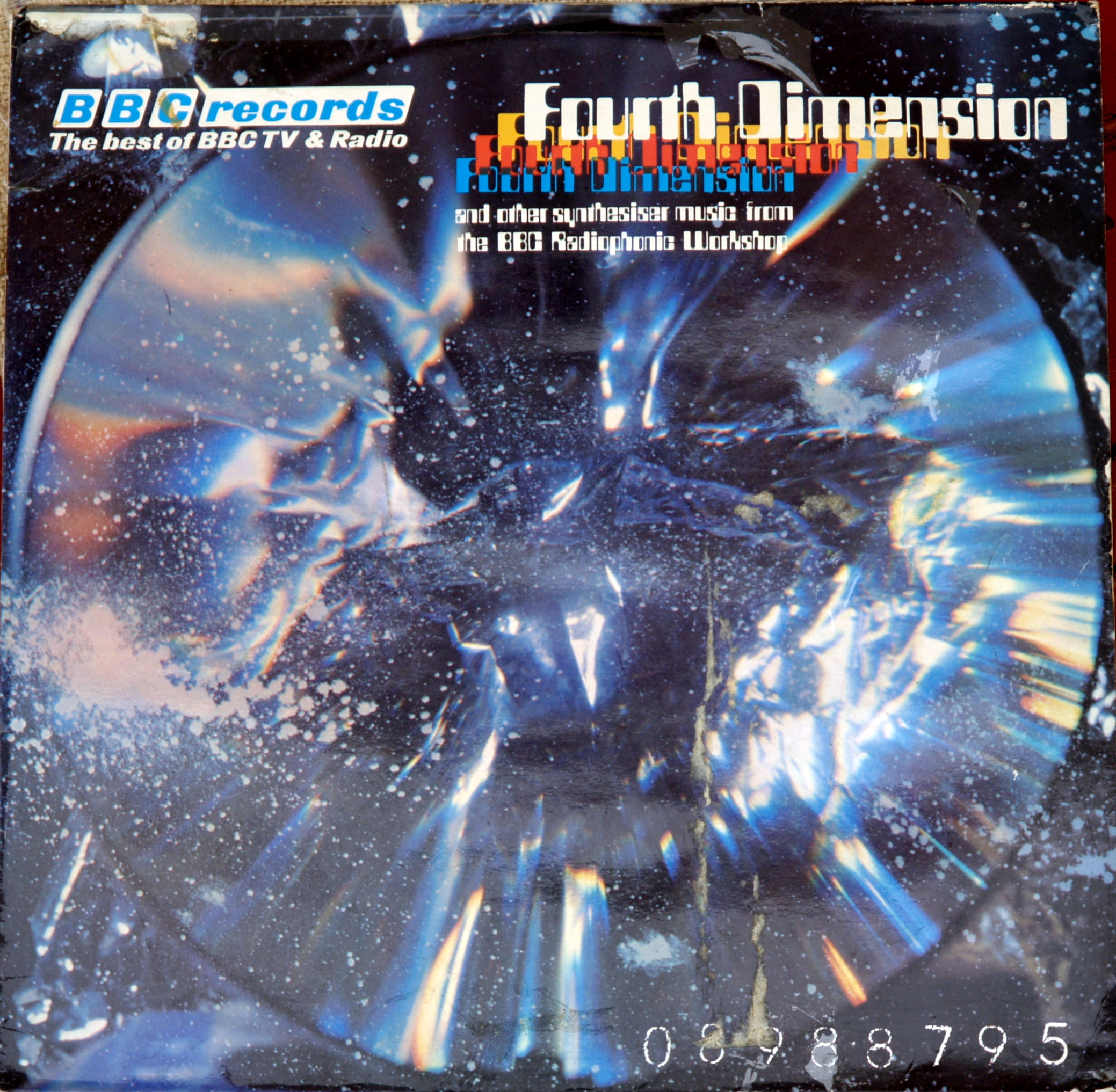
 Robin The Fog